Condensation in Acrylic Card Cases: Causes, Dew Point, and Fixes
Condensation in Acrylic Card Cases: Causes, Dew Point, and Fixes
Condensation in an acrylic card case forms when warm, humid air is trapped inside and then cooled, so moisture beads on the cooler acrylic walls and can reach the card surface. The fix is not simply "seal it tighter": it is managing room humidity, avoiding fast temperature swings, choosing between sealed and vented designs on purpose, and drying a fogged case correctly. For retailers, importers, and distributors buying display and storage programs at volume, the practical answer is to specify cases, desiccant options, and packaging that match the climate your customers actually store cards in.
What Causes Condensation in Acrylic Card Cases
Three conditions have to line up: moisture in the air, a trapped air volume, and a temperature difference. A display case closed in a warm room captures air at that room's humidity. When the case cools later — a shop turning off air conditioning overnight, a parcel sitting in an unheated warehouse, a case carried from a cold car into a warm humid store — the air inside drops below its dew point and the excess moisture has to go somewhere. Acrylic is a poor thermal conductor compared with metal, so the inner wall lags behind the room, which is exactly where beads form first.
Clear acrylic also hides the problem for a while. Fog looks like a light film or a smudge, and many collectors wipe the outside and assume the case is clean. Meanwhile the card stock is absorbing and releasing moisture with every cycle. Paper-based collectibles are hygroscopic: they swell slightly as relative humidity rises and shrink as it falls, and repeated cycles are what eventually produce the wavy edges and curled corners that grading companies flag as handling or storage damage.
There is a second, easily overlooked source: the case itself plus what goes in with it. Foam inserts, cardboard inner trays, paper sleeves, and wooden display cabinets all hold moisture and release it slowly into a closed volume. A brand-new insert that spent a week in a humid warehouse can raise the humidity inside a sealed case for days after assembly. This is why buyers who source cases and inner packaging separately should ask for moisture content and drying information, not just dimensions.
Temperature Swing, Humidity, and Dew Point Explained Simply
Warm air holds more water vapor than cold air. Relative humidity is a ratio: the same amount of water vapor reads as a higher percentage when the air cools. The dew point is the temperature at which that air can no longer hold its moisture and starts depositing it on surfaces. Practical example: a stockroom at 25°C and 60% relative humidity has a dew point near 17°C. Any surface at or below roughly 17°C will collect water. That is well within normal overnight temperature drift in an unconditioned shop, and it is why cases that were perfectly dry in the afternoon can be fogged in the morning.
Conservation guidance gives useful reference bands even though trading cards are not museum objects. The American Museum of Natural History advises keeping collection environments in the 40-60% relative humidity range while minimizing dramatic swings. Museums Galleries Scotland puts paper collections at roughly 40-50% RH, and the Western Australian Museum manual recommends 45-55% RH with no more than about ±5% variation in any 24-hour period. Treat those as best-practice anchors for high-value slabs and sealed product, not as a claim that every retail shelf needs a climate chamber.
Two numbers matter more than the absolute reading. First, how fast humidity changes: a drop of 20 percentage points in an hour is far more damaging than a steady 62% all week. Second, the temperature gap between the acrylic surface and the room: the closer they are, the less likely you cross the dew point. Cheap hygrometers with min/max memory cost very little and will tell you both, which is why we recommend them to retailers as a merchandising accessory rather than a collector gadget.
Sealed vs. Vented Cases: Where Moisture Comes From Compared
Neither design is universally correct. A sealed case slows air exchange, which keeps out dust and odor but also traps whatever moisture entered at closing time, including moisture released by inserts. A vented or gasketed case trades a small amount of exchange for pressure equalization and slower, gentler humidity movement. The table below compares the options buyers most often ask us about, ranked by how they behave in humid retail environments.
| Case type | Moisture behavior | Best use | Main risk |
|---|---|---|---|
| Fully sealed acrylic box | Very low air exchange; traps air at closing humidity | Dry, stable, air-conditioned display rooms | Slow moisture build-up from inserts; fog after cold transport |
| Screw-down acrylic case | Compressed joint, minimal exchange, serviceable | Single high-value slab on a retail counter | Uneven torque can leave a slow leak path |
| Slab storage case with snug lid | Low exchange, easy to reopen for desiccant changes | Multi-slab inventory storage | Lid gasket wear after repeated opening |
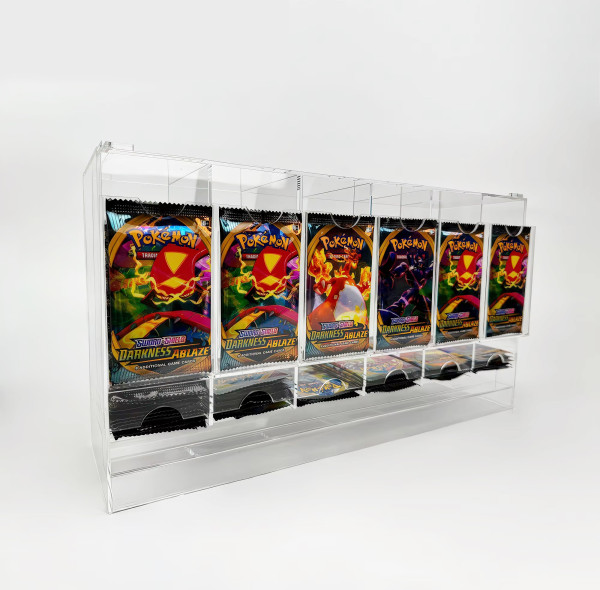
| Vented or slotted display case | Controlled exchange; follows room humidity slowly | Humid climates, busy shops, seasonal markets | Dust ingress; needs periodic cleaning |
| Wooden or MDF display cabinet | High buffering, slow release of stored moisture | Permanent home display with stable room | Adhesives and finishes can off-gas; moisture reservoir |
| Cardboard or paper inner tray | Acts as a humidity sponge inside any case | Short-term transport only | Raises internal RH for days after packing |
| Soft sleeve plus toploader | Breathable; no internal volume to trap air | Daily handling and shipping protection | No barrier at all against humid air |
The comparison also clarifies a common buying mistake: teams order a sealed case for a humid market because "sealed sounds safer," then discover that the trapped air plus a paper insert is the worst combination. If your customers are in coastal or monsoon climates, a vented design with a desiccant pocket, or a sealed design shipped with a preconditioned dry insert, usually outperforms a plain sealed box.
How to Choose Acrylic Card Cases and Desiccants for Humid Climates
Start from the storage environment, not the product photo. Ask three questions: what is the average room humidity, how large are the daily temperature swings, and will the case be opened often? A collector room that holds 45-50% RH with air conditioning needs little more than a good seal. A shop with open doors in a 75-85% RH season needs vents, desiccant capacity, and staff instructions. Then match the hardware:
- Wall thickness and joint quality. Thicker cast acrylic resists warping and holds a cleaner joint; a poorly bonded joint is a permanent slow leak that no desiccant can outrun.
- Gasket or seal type. Compression gaskets work but age; specify a material rated for repeated opening if the case is a working display.
- Desiccant capacity. Silica gel packets must be sized to the internal air volume and refreshed. A pocket or compartment keeps the packet off the card.
- UV filtering. Humidity is not the only aging factor; UV-blocking acrylic reduces color fade in sunlit retail displays.
- Insert materials. Specify acid-free, low-moisture foam or EVA where the case touches a graded slab.
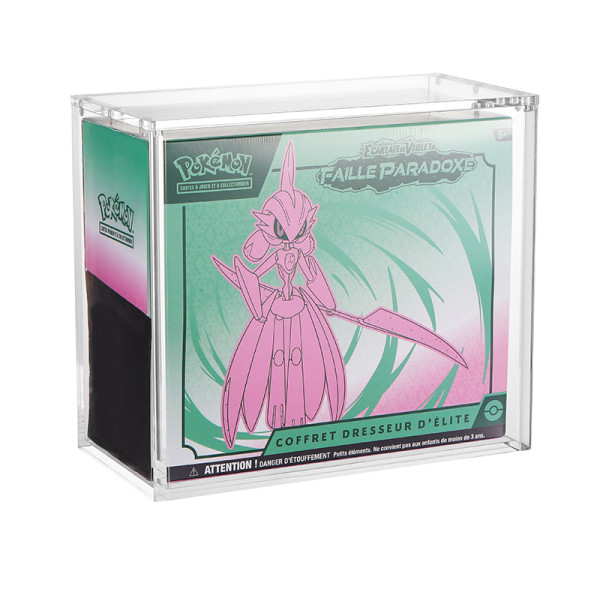
For slabs specifically, look at how the case holds the holder rather than the card. Graded holders from PSA, BGS, and CGC differ in thickness, and a case with foam cut to one thickness will rattle or pinch the others. Multi-slot organizers that accept mixed holders are easier to sell into shops that buy collections. Our graded card slab accessories line is built around that mixed-inventory reality, and the 12-slot acrylic graded card storage case is the version most distributors start with. If you are also merchandising sealed product, the humidity logic is the same but the volume is larger — see our guide to best acrylic display cases for Pokemon ETBs in 2026 for box-scale sizing.
Fix Steps: Drying Out a Case Without Warping Cards
When a case is already fogged, speed matters less than stability. Do not blast it with a hair dryer, do not put it in direct sun, and do not move it straight from a cold vehicle into a warm humid room. Work in this order:
- Equalize the temperature first. Move the closed case to the final room and leave it shut for several hours so the acrylic and the card reach room temperature together.
- Open in a dry space. Open only in a room you have measured at 45-55% RH. Opening in a humid room simply swaps wet air for wetter air.
- Remove the card, not just the lid. Take the card or slab out, place it flat on a clean dry surface away from sunlight and airflow, and let it acclimatize for 24 hours.
- Dry the case separately. Wipe with a soft microfiber cloth, leave the case open in the dry room, and let the gasket channel dry completely before closing.
- Replace the desiccant, do not recharge it in place. Silica that has done its job is saturated; refresh or replace it, and never bake a packet next to cards.
- Reassemble in the driest hour of the day. Mid-afternoon in an air-conditioned room is usually better than early morning.
If a card has already taken a wave or curl, flattening it under weight is a last resort that risks surface damage, and graders treat it as a defect regardless. Prevention is cheaper than correction, which is the argument for building humidity control into the product spec rather than selling it as an afterthought.
Warning Signs: Fogging, Beading, and Wavy Card Stock
Fogging is early-stage: a faint film on the inner wall that disappears when the room warms. Beading is advanced: visible droplets, which mean the dew point was crossed inside the case. Wavy edges, a slight bow across the face, and a dulling surface are later signs that the card stock has cycled repeatedly. At that stage the acrylic is not the problem, the environment is, and no case upgrade will reverse it.
For retail staff, a simple weekly check works: look at the inner surface of three display cases at opening time, before the room warms. Fog in the morning and clear by noon is a temperature-swing signature — fix ventilation or overnight HVAC. Fog that persists all day points to a moisture reservoir: an insert, a wooden cabinet, or a case closed in a humid room.
Humidity Maintenance Best Practices for Collections
Keep the room inside a 40-60% band and accept that the band matters less than the smoothness of the line. Log min/max readings weekly, place hygrometers at case height rather than on the floor, and keep cases off exterior walls and away from windows where surface temperature drops fastest. Never store cases in a garage, attic, or uninsulated container. When shipping, pack with the case closed in a dry room, include desiccant outside the case in the outer carton, and tell the buyer to let the parcel reach room temperature before opening — the same instruction that protects electronics protects card stock.
Wholesale and Retail Notes for Buyers (MOQ, Packaging, Lead Time)
Humidity-related returns are almost always a specification problem, so treat them as a purchasing line item. GUARD TCG has manufactured cases and card accessories since 2009, produces more than 300 million units a year, and supplies 10,000+ customers and 500+ distributors across 70+ countries, so we can quote both stock designs and OEM/ODM variants with vented panels, desiccant pockets, gasket changes, or UV-filtering acrylic. MOQ starts at 100 pieces for standard items; custom tooling and print runs are quoted per project.
| Buyer question | What to specify | Typical lead time |
|---|---|---|
| Humid-climate retail | Vented panel or desiccant pocket, corrosion-resistant hardware | Stock 3-7 days; production 20-30 days |
| Air-conditioned collector market | Sealed or screw-down, acid-free insert | Stock 3-7 days |
| Distributor cartons | Individually bagged, desiccant in outer carton, export-grade master case | Production 20-30 days |
| Private label program | Logo, insert card, retail-ready packaging | 25-35 days after artwork approval |
Express shipping by DHL, FedEx, or UPS runs 5-12 days door to door for samples and small orders; sea freight is 25-35 days and is the normal route for container volumes. Every batch is fully inspected before packing, and we can add a moisture-barrier bag step for humid destinations on request. For custom programs and OEM/ODM terms, start at our OEM/ODM services page, browse the full product catalog, or send requirements through the inquiry form.
About GUARD TCG
GUARD TCG is a trading card protection and display manufacturer founded in 2009, producing acrylic display cases, card storage boxes, sleeves, toploaders, and graded-slab accessories for collectors, retailers, and distributors. We run OEM and ODM programs for brand owners and supply 10,000+ customers through 500+ distributors in more than 70 countries, with annual output above 300 million units and full batch inspection before shipment. Our team writes these guides from factory and wholesale experience, not from sponsored placements.
FAQ
Does silica gel really stop condensation in an acrylic card case?
It lowers the moisture available inside a closed volume, so the dew point drops with it. It cannot compensate for a leaking joint or a case that is opened in a humid room, and saturated packets stop working, so refresh them.
Is a sealed case better than a vented case for cards?
Only in a dry, stable room. In humid climates a vented design or a desiccant pocket usually produces fewer problems, because trapped air plus a paper insert becomes a moisture reservoir.
Can I dry a fogged case with a hair dryer?
No. Localized heat warps acrylic and drives moisture into the card faster. Equalize temperature, open in a dry room, and let everything air-dry flat.
What relative humidity should I target for graded slabs?
Conservation guidance for paper-based collections sits around 40-50% RH, with museum practice accepting 40-60% while minimizing rapid swings. Keep daily variation small rather than chasing one exact number.
Do you offer cases designed for humid markets?
Yes. Vented panels, desiccant compartments, gasket options, and moisture-barrier packing are available as stock variants or OEM/ODM modifications, with MOQ from 100 pieces.
Conclusion
Condensation in an acrylic card case is a physics problem, not a product defect: warm humid air gets trapped, the case cools below the dew point, and water appears on the wall closest to the card. Fix it by keeping the room in a 40-60% band with small daily swings, matching sealed or vented designs to the climate, replacing saturated desiccant, and drying a fogged case slowly at room temperature. For buyers building a storage and display program, the cheapest insurance is specification — choose gaskets, desiccant capacity, and inserts that suit the humidity your customers actually live in, and document the handling steps on the packaging.