Custom Card Binder Manufacturer: Artwork, Sampling, and MOQ
Custom Card Binder Manufacturer: Artwork, Sampling, and MOQ
A custom card binder project runs through four gates: artwork and dieline approval, a physical sample, MOQ confirmation, and production slots. For importers, distributors and retail buyers sourcing private-label binders, expect MOQ of roughly 100–500 units for standard constructions with custom covers, a 7–12 day sampling window, and 20–30 days of production after sign-off. Most delays are unresolved colour references, which is why experienced buyers lock Pantone values and material specs before paying a deposit.
What a Custom Card Binder Manufacturer Does
A custom card binder manufacturer is not a printer that glues a logo onto a stock album. The work runs across six steps: material sourcing, pocket film forming, cover lamination, binding or sewing, closure fitting and final inspection. Each step has its own tolerances, and each is a place where a vague spec produces a surprise.
The customisation layers are narrow but combinable. Cover material: PU leather, 600D polyester, PP board, EVA-backed fabric or laminated paper. Print method: silk screen for one or two spot colours, heat transfer for photographic artwork, sublimation for all-over patterns, debossed metal plate. Pocket configuration: 9, 12, 16 or 40-pocket single-sleeve, side or top loading, fixed pages or a ring mechanism.
Closure and packaging decide the retail price point: coil zipper, elastic band, magnetic flap or slipcase, and polybag versus printed box.
Why the First Sample Decides Everything
In contract manufacturing the sample is the contract. A drawing can specify a pocket depth to the millimetre, but not whether the film feels stiff enough to hold 360 cards without bowing, whether the zipper pull clears the cover print, or whether corner stitching puckers after a fortnight in a warehouse.
That makes a first sample a commercial document. Retail buyers photograph it for listings, distributors show it to accounts, and every later unit is judged against it — including the inspection that accepts or rejects the bulk shipment.
The expensive mistake is approving a sample that is close enough on a verbal promise. Bulk is the sample multiplied a few thousand times, variance included; a seam 2mm off on a one-off will wander on a run.
Artwork, Dielines, and Colour References
A dieline is the flat template that maps artwork onto a three-dimensional product: trim line, bleed, fold lines, seam allowance where the cover wraps the board, stitch line, and the position of zipper opening, handle and patch window. Ask the factory for its own vector file rather than drawing one from a photo.
Two rules decide whether artwork survives production. Keep critical elements 5mm inside the stitch line, because seams pull material and a logo on a seam distorts. Supply colour as Pantone solid coated references, with a physical swatch if the colour is brand-critical, and agree a Delta E tolerance — 2 or better is common on coated stock, harder on textured PU.
The same Pantone never looks identical on four substrates. Number 186 on glossy paper, matte PU, 600D polyester and moulded PP reads as four reds under retail lighting, so approve brand colour on the actual substrate.

A 16-pocket leather binder makes a typical first sample: cover wrap, stitch line and pocket geometry visible in one photo, so the unit can be compared directly against the approved dieline.
Sample vs Pre-Production Sample Compared
Buyers use "sample" and "PP sample" interchangeably, and that confusion costs weeks. They are two approvals with different jobs.
| Stage | Purpose | Materials used | Typical timing | What can still change |
|---|---|---|---|---|
| Concept sample | Test construction and feel | Stock or nearest-match materials | 5–8 days | Everything |
| Custom sample | Check artwork, colour, logo placement | Specified materials, proof print | 7–12 days | Artwork, colour, hardware |
| Pre-production sample | Approve the exact bulk build | Production materials and print | 3–7 days after deposit | Minor only — this is the standard |
| Golden sample | Sealed reference for inspection | Signed PP sample | Same as PP | Nothing |
| Shipping sample | Pull from bulk, verify against golden | Finished goods | At final inspection | Nothing — accept or rework |
| Salesman sample | Show retail accounts before bulk lands | Production build, early run | Before vessel departure | Nothing; it is a promise |
| Cost of skipping | Rework, air freight, missed launch | — | 2–6 weeks lost | Not recoverable |
The PP sample is the one that matters: built from production materials on production equipment, then a signed unit is sealed as the golden sample. Quality becomes a comparison against a physical object both sides have signed.
MOQ, Tooling, and Price Break Structure
MOQ exists because setting up a line has a fixed cost spread across units: print screens or transfer plates, a cutting die, machine settings, a first-article inspection. Over 100 units those costs dominate price; over 3,000 they nearly disappear.
Standard constructions with a custom cover typically start at 100–500 pieces per style and colour, assuming an existing shell and layout with new artwork on top. A new body size, pocket count or closure means new tooling, and tooling means a higher entry quantity or a development charge.
Price breaks matter more than headline MOQ, so ask for a ladder — 500, 1,000, 3,000 — and read where the curve flattens. If 500 to 1,000 saves 12% and 1,000 to 3,000 saves 4%, the efficient order is 1,000. Industry estimate: for sewn and laminated binders, material is roughly half of unit cost, labour a fifth to a third, packaging the rest — which is why film gauge and board weight move price faster than a logo change.
Tooling should be quoted separately: die, plate, sample cost, and whether the die is retained for your account. A supplier who will not separate those numbers has absorbed them into unit price.

A toploader binder is a stress test for a new supplier: pockets must hold rigid 35pt holders without splitting seams, which exposes film gauge and stitch quality faster than a 9-pocket page.
How to Choose a Custom Card Binder Manufacturer: 6 Checkpoints
1. Category focus. A factory already running card binders has the dies, welding equipment and fitting experience you would otherwise pay to develop. Ask what share of output is card storage.
2. Process ownership. Ask which steps happen in-house. Cutting, laminating, sewing, zipper setting and packing under one roof shortens lead time; a supplier subcontracting all five controls your delivery date less.
3. Sampling policy. Ask the sampling lead time and whether the charge is credited against bulk. A supplier quoting 30 days for a sample will not hit a 25-day production window.
4. Quality system. Ask for the inspection standard, not the word "QC". AQL 2.5 for major defects and 4.0 for minor is a common retail benchmark; a factory showing photo reports and defect classification is easier to hold to a spec.
5. Compliance documents. Depending on market you may need REACH statements, CPSIA or Prop 65 declarations, phthalate-free film certificates or a social audit. Ask before the PO.
6. Communication and capacity. Response time at enquiry stage predicts response time during a production problem. Confirm the production slot in writing and check your order against set releases or holiday cut-offs.
From Approved Sample to Delivery
Once the golden sample is sealed, the project becomes documentation. The purchase order should restate every specification that mattered: dimensions, pocket count and film thickness, cover material and colour reference, logo method, closure, packaging format, carton quantity and marking. Ambiguity here is what a factory resolves in its own favour.
Then: deposit, material booking, pre-production inspection on raw materials, in-line check during cutting and sewing, final inspection, freight booking. Ask for the final report with photographs before goods leave, and for larger orders bring in a third-party inspector for an independent AQL check. Book freight at PO date, not at completion — switching from sea to air later is how a well-managed project still misses its window.
Common Mistakes That Delay First Orders
Approving colour from a screen proof is the first mistake: a monitor cannot show how ink sits on textured PU. The second is artwork without a dieline, so the logo lands on a stitch line. The third is changing artwork after the PP sample, restarting the approval clock.
The fourth is splitting a small order across three colours, tripling setup cost. The fifth is under-specifying pocket film, then finding loaded pages bow the cover. The sixth is forgetting retail packaging — inner packs, barcodes, hangtag holes, carton marks — until goods are finished. The seventh is leaving compliance documents to the end.
Wholesale and Retail Notes for Buyers (MOQ, Packaging, Lead Time)
For a buyer building a private-label programme, commercial details are the product. GUARD TCG runs MOQ from 100 pieces per style, workable for a single-store test and sensible for a distributor building a range across three or four constructions.
Packaging is where margin hides. Specify inner pack quantity, polybag or colour box, hangtag, barcode and carton marking at quotation stage; changing them after tooling is a second project. Custom covers, branded pulls and printed packaging run through our OEM/ODM programme.
Lead time is 5–12 days by DHL, FedEx or UPS and 25–35 days by sea after sample approval. Run the first order by air, then move the repeating SKU to sea. Every batch is inspected; we have supplied 10,000+ customers through 500+ distributors since 2009.
Send artwork, quantity and packaging requirements through our inquiry form — the first response should be a dieline and a costed sample plan, not a catalogue.

A 360-card, 9-pocket build is the volume SKU in most ranges: it suits retail shelving and takes a printed sleeve without second-round tooling.
About GUARD TCG
GUARD TCG is a trading card protection manufacturer founded in 2009, producing 300 million+ pieces a year for 10,000+ customers and 500+ distributors in 70+ countries. We make sleeves, toploaders, slab accessories, binders, storage boxes and acrylic display cases, supplying wholesale and OEM/ODM programmes with MOQ from 100 pieces. Every batch is inspected before shipment, and our team supports importers with packaging specification, private label development and freight planning. Start with the card binder range or the full product catalogue.
FAQ
Q1: What is a realistic MOQ for a custom card binder?
Around 100–500 pieces per style and colour for a standard body with custom artwork. A new size, pocket layout or closure adds tooling and raises the entry quantity. Ask for a price ladder rather than one number.
Q2: How long does sampling take, and what does it cost?
Plan on 7–12 days for a custom sample with your artwork, a few days more if a new die must be cut. Samples are usually charged and credited against bulk — confirm that in writing, and that the sample uses production materials.
Q3: Can I get my brand on a binder without a full custom build?
Yes. Screen or heat-transfer logos on an existing shell, a branded pull or a printed belly band are cheapest and keep MOQ low. Full custom covers are a development project with a higher entry quantity.
Q4: What should the pre-production sample approval include?
Colour against the reference, dimensions, pocket count and film gauge, stitch quality, closure function, logo placement against the dieline, and packaging in final form. Approve one unit and seal it as the inspection standard.
Q5: How do I avoid a delay on my first order?
Lock colour and material references before the deposit, approve artwork on a dieline, freeze specs after the PP sample, and book freight at PO date. Most first-order delays are specification changes, not production failures.
Conclusion
A custom card binder manufacturer is chosen on process, not on a price list. Approve the dieline, measure colour on the real substrate, insist on a production-material PP sample, seal a golden unit and put every spec into the PO. Then MOQ, tooling and lead time become arithmetic instead of negotiation.
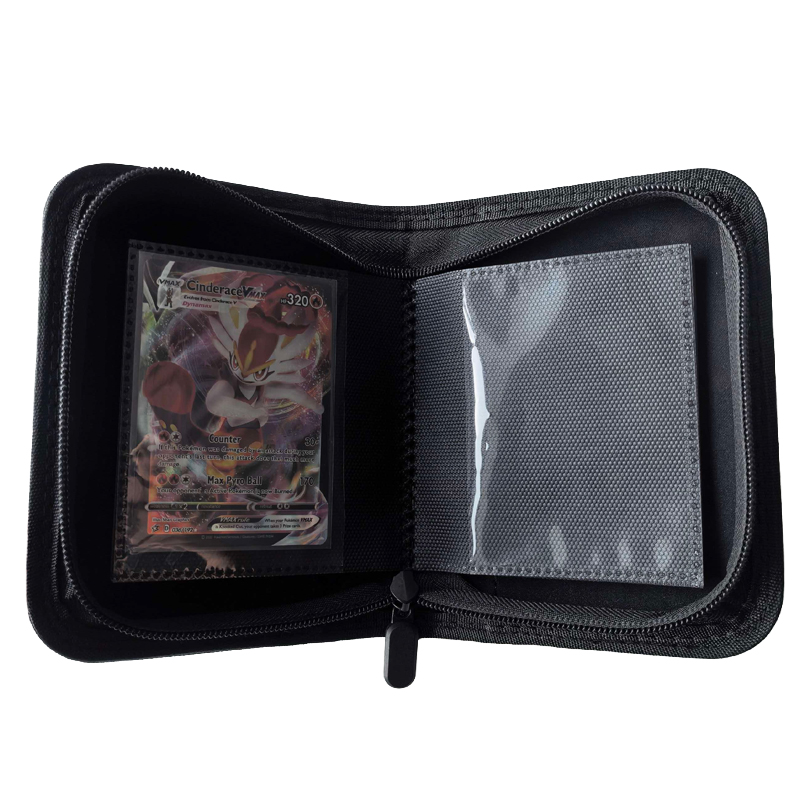
Zippered single-sleeve formats are the fastest-growing retail request we see: they photograph well, travel well and hold a higher price than a plain 9-pocket album. If that is where your range is heading, send the spec sheet early.