Graded Card Case Wholesale: Buying Slab Storage in Bulk
Graded Card Case Wholesale: Buying Slab Storage in Bulk
Buying graded card storage in bulk changes the specification. Choose stackable 1-4 slot cases or 4-row EVA boxes that ship flat or nest to cut freight, confirm foam density and no-flake material, and insist on carton drop-test data before you commit. Unit cost typically drops 15-30% from 100 to 1,000 units, but packaging volume often eats those savings on sea freight. For retailers, distributors, and importers building a slab storage line, this guide covers the graded card case wholesale decisions that move landed cost: slot format, foam, carton cube, and inspection.
What a Wholesale Graded Card Case Order Really Looks Like
A retail buyer orders a display-ready unit. A wholesale buyer orders a cube of freight with a spec attached. That difference drives every decision here: slot count, foam grade, lid mechanism, carton dimensions, and pallet pattern are chosen together, because a case that costs 20 cents less but adds 4 cm of height to every master carton can lose money on the container.
Demand is steady rather than seasonal. Grading volume at PSA, BGS, CGC, and SGC has turned slab storage into a repeat retail category: every graded card that comes back from a submission needs somewhere to live. That is why buyers now ask for graded guard wholesale terms rather than single-unit pricing.

Why Bulk Slab Storage Specs Differ From Retail
Retail specs are written for the shopper: the case must look good on a peg, feel solid, and photograph well. Bulk specs are written for the pallet: a fixed external dimension that palletizes cleanly, a lid that survives compression, foam that does not shed onto slabs during a 30-day ocean transit, and a master carton that hits a target cube.
The second difference is tolerance. A retail case that is 1 mm loose is an annoyance; multiplied by 500 units in one carton it becomes rattle, abrasion on slab corners, and untraceable returns. Write an external dimension, an internal slot dimension, and a foam compression figure into the order, each with a tolerance. A factory that can only say "fits PSA slabs" has not given you a spec.
Slab Standards You Have to Design Around
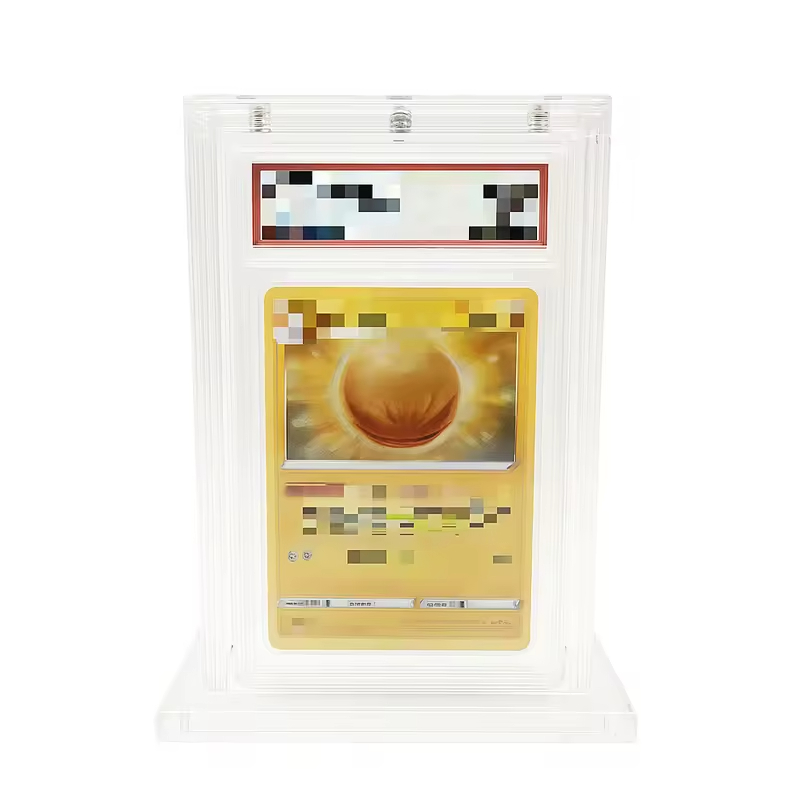
Graded slabs are not one size. Public 2026 slab size guides put PSA near 3.25 x 5.375 in, BGS at about 3.20 x 5.125 in, CGC/CSG near 3.125 x 5.25 in, and SGC around 3.392 x 5.460 in, with thickness clustering near 0.25-0.30 in. SGC being the widest is the detail that catches importers: a case tooled tightly to PSA will not accept an SGC slab, and shops rarely sort stock by grader.
The practical answer is a slot that clears the widest common slab with 1.0-1.5 mm of clearance per side, plus a foam or EVA insert that takes up the slack on narrower slabs. Design for the widest and shim for the rest.
Stackable 1-4 Slot Cases vs. 4-Row Boxes Compared
The two workhorse formats answer different questions: small-slot cases are a retail unit a collector buys one at a time, four-row boxes are a storage unit a shop buys once. Both belong in a range, but they carry different freight math.
| Factor | Stackable 1-4 slot case | 4-row EVA / storage box |
|---|---|---|
| Typical use | Retail single unit, display piece | Shop back room, heavy collector storage |
| Capacity | 1-4 slabs | 40-100+ slabs by row depth |
| Freight profile | High cube per slab, nests or ships flat | Low cube per slab, rigid box |
| Unit cost | Lower per piece, higher per slab stored | Higher per piece, far lower per slab stored |
| Foam dependency | Moulded insert or EVA blocks | Full-length foam rows or dividers |
| Transit risk | Lids and corners, compression | Row collapse, foam shedding |
| Best for | Counter display, gift, subscription box | Inventory storage, convention stock |
Foam Density, Fit, and No-Flake Requirements
Foam is where cheap programs fail. Low-density polyethylene foam compresses permanently under a stack of master cartons, so the slot that gripped a slab on day one is loose on arrival. Ask for density in kg/m3 and a compression set figure, and test a filled carton under load for 72 hours instead of trusting a hand squeeze at sampling.
No-flake is the other non-negotiable. Foam that sheds crumbs deposits grit against acrylic, and acrylic is soft enough that grit leaves visible scratches in transit. Specify closed-cell or skinned foam, or a flocked EVA insert, and require a rub test against a clear acrylic panel. For archival claims, add a material statement confirming the foam carries no migrating plasticizers.
Custom Graded Card Case Programs
A custom graded card case is usually one of three things: a logo on a stock shell, a new slot layout inside a stock shell, or new tooling. The first is fast, the second needs a mould insert and a sample cycle, the third needs amortisation and much higher volume. Most distributors should start with the first two.
Bring the factory a real slab, not a drawing. Send the widest slab you intend to serve plus a second grader's slab, state the slot count range, and ask for a fit sample in the intended foam grade. For retail chains, also state the shelf or peg constraint, because a case that stacks beautifully but does not fit the fixture is still a failed SKU.
Price Breaks by Order Volume
Volume pricing is not linear or uniform. Moulded and tooled items fall faster because setup and tooling are amortised; folded or sewn items fall more slowly because material dominates. The curve below is an industry estimate, not a quotation.
| Order tier | Typical unit cost change | What drives it |
|---|---|---|
| Sample, 1-20 pcs | Baseline, highest per unit | Setup, single-piece handling |
| 100 pcs | 15-30% below sample | Batch run, shared setup |
| 500 pcs | Another 8-12% below 100 | Material buying, longer run |
| 1,000 pcs | Another 5-8% below 500 | Tooling amortisation, line efficiency |
| 3,000 pcs+ | Marginal, negotiated | Capacity booking, payment terms |
| Custom tooling | Adds a one-off charge | Mould cost amortised over the run |
Two cautions. The cheapest tier is rarely the cheapest landed cost if it pushes you into a carton that cubes out badly. And a 500-piece order at a good price with a 45-day lead time can cost more in lost sales than 300 pieces landing in 15 days. Model landed cost, not ex-works price.

Carton Design and Freight Volume
Freight volume is the silent margin killer. Slab cases are bulky and light, so you pay for cube rather than weight, which makes carton engineering a purchasing decision. Confirm units per carton, cartons per pallet, and pallets per 20ft and 40ft container before you approve the price.
For small-slot cases, ask whether the shell ships flat for assembly at destination, or whether two units nest lid-to-base. Either change can cut cube 20-40%, which usually beats a 5% unit price concession. For rigid four-row boxes, the levers are pallet pattern and wall grade. Sea freight from China runs 25-35 days door to door, express lanes 5-12 days, so a fast express lane plus a slow sea lane suits a new SKU.
How to Choose a Slab Storage Supplier
Shortlist on capability, then price. A supplier worth a bulk order shows four things: an existing slab storage line rather than generic boxes, a stated foam grade with a material statement, carton drop-test and compression data, and a documented inspection routine. Public marketplaces list acrylic slab protector cases around US$0.55-0.65 per piece at 500-piece MOQ, which marks the floor for simple acrylic work; a quote far below that changed wall thickness or foam.
Then check the boring items: who owns the tooling, whether colour and finish hold across reorders, the reorder lead time, and who pays for rework if the foam grade drifts. A trading company suits a mixed small order; a factory relationship keeps a repeat SKU stable.
Quality Checks Before Shipment
Write inspection into the purchase order: a fit check with the widest and narrowest slab in your range, a lid cycle test of 50 open-close cycles, a foam rub test against acrylic, a loaded-stack test for 72 hours, and a carton drop test. Photograph each check and attach it to the shipping documents.
Batch inspection matters more than sample inspection, because the failure mode here is drift: the first 200 units fit and the last 200 come off a different foam lot. Ask for AQL-based inspection on the finished batch and a sealed retained sample per lot. In a dispute three months later, that sample is the only evidence that counts.

Wholesale and Retail Notes for Buyers (MOQ, Packaging, Lead Time)
MOQ. Stock slab storage formats typically start at 100 units per SKU, low enough to test a market without tooling spend; custom shells, new slot layouts, and logo programs usually need 500-1,000 units because of setup and mould cost. Mixed containers work when several SKUs share a carton plan, so aggregate your range before negotiating.
Packaging. Decide early between retail-ready packaging (printed sleeve, hang tag, barcode, country of origin) and plain export cartons. Retail-ready adds cost and lead time but removes repacking at your warehouse. For e-commerce, request a mailer-grade outer that survives parcel handling without an overbox, and confirm packaged weight and dimensions for your shipping calculator.
Lead time. Allow 5-12 days for express samples, 25-35 days for sea freight, plus production time set by format and finish. Land the first order six to eight weeks before your season and reorder on sell-through, not the calendar. On a repeat program, inspection rights and payment terms are worth more than a few cents of unit price.
Best Practices for Retail and Distributor Stock
Carry depth in two formats and breadth in finishes, not the reverse. A distributor stocking six shell colours but one slot count loses the shop that needs four-slot cases. Keep core slot configurations in plain finish as volume SKUs, and treat colour, embossing, and gift packaging as the margin SKUs.
Store cartons off the floor and out of direct sun, because heat cycles soften foam and warp thin acrylic over months. Rotate first-in-first-out and keep one opened carton as a reference unit. Publish slot compatibility on the product page: naming the graders and slab sizes a case accepts cuts returns more than any packaging upgrade.
About GUARD TCG
GUARD TCG has manufactured card protection and display products since 2009, producing more than 300 million units a year for customers in over 70 countries, with 10,000+ customers and 500+ distributors. We run OEM and ODM slab storage programs with documented dimensions, foam grades, and carton data, a 100-unit MOQ on stock formats, full-batch inspection, and express or sea shipping. For a graded card case wholesale quote, start with the OEM/ODM program page, browse the graded card slab accessories catalog, or send your slab dimensions through the inquiry page.
FAQ
Q1. What is a realistic MOQ for a graded card case wholesale order?
Stock formats commonly start at 100 units per SKU. Custom shells, new slot layouts, and logo programs typically need 500-1,000 units because of setup and tooling cost.
Q2. Will one case fit PSA, BGS, CGC, and SGC slabs?
Only if the slot is designed for the widest slab, SGC at roughly 3.392 x 5.460 in, with a foam or EVA insert to take up slack on narrower PSA, BGS, and CGC slabs.
Q3. How much cheaper is 1,000 units than 100 units?
As an industry estimate, unit cost falls 15-30% from sample to 100 units, then another 8-12% at 500 and 5-8% at 1,000. Compare landed cost, not unit price.
Q4. What foam should I specify for bulk slab storage?
Closed-cell or skinned foam with a stated density and compression set, or a flocked EVA insert. Require a no-flake rub test and a statement free of migrating plasticizers.
Q5. How do I reduce freight cost on slab cases?
Engineer the cube: ship small cases flat or nested, adjust carton dimensions and pallet pattern, and check cartons per container before approving the price.
Conclusion
Bulk slab storage rewards buyers who treat it as a specification problem rather than a price list. Design the slot for the widest slab you serve, lock the foam grade and no-flake requirement in writing, engineer the carton for cube, and put fit, cycle, stack, and drop tests into the purchase order. Then buy on landed cost and reorder on sell-through, and a graded card case wholesale program becomes a stable repeat category. To compare formats against your own slab range, browse the full catalog or request a fit sample through the inquiry page.