Japanese vs English Booster Box Cases: Why Size Matters
Japanese vs English Booster Box Cases: Why Size Matters
Japanese and English booster boxes often look similar but differ in height, width, and lid thickness, so a case that fits one can crush or rattle the other. Measuring the actual box, not the product line, is the reliable rule. Knowing the standard Japanese and English footprints before you buy prevents returns and keeps sealed value intact. For retailers, importers and distributors, that single discipline — measure the carton in hand, then match the Japanese vs English booster box case to it — is what separates a display programme that sells from a pallet of unusable acrylic that never leaves the warehouse.
Why Japanese and English Booster Boxes Are Not Interchangeable
The two regional versions exist to serve different markets, and that difference shows up in the packaging long before it shows up in the cards. An English-language booster box is built around a 36-pack display: larger packs, more cards per pack, and a deeper carton to hold them. A Japanese booster box typically carries fewer packs with fewer cards each, so the box is thinner and lighter for the same set.
To a buyer skimming a product photo, the two boxes can look almost identical in footprint. Up close, the depth is the giveaway. When a collector or a shop orders a case sized to the "wrong" region, the result is one of two failures: the box will not seat because the case is too shallow, or it drops in with enough slack that it shifts on every shelf bump and scuffs the printed wrap. Neither is acceptable for sealed inventory that is meant to hold its value.
At wholesale scale the problem compounds. A distributor carrying a mixed-language catalogue — English for North America and Europe, Japanese for the domestic-Market and collector channels — needs two tooling specifications, not one, even when the set name is the same. Treating "booster box case" as a single SKU is the most common sourcing error we see from new importers, and it is almost always discovered only after a container has landed.
A clear case built for the slimmer Japanese carton keeps that box from sliding, which is exactly the protection a generic case cannot deliver.

What Actually Differs: Height, Width, and Lid Thickness
Three measurements decide whether a case fits, and buyers should record all three for every version they stock.
- Depth (front-to-back): the biggest split. English 36-pack boxes are noticeably deeper because of the larger, fuller packs inside, while Japanese boxes run roughly half that depth.
- Height and width: closer between regions than most people expect, which is precisely why the difference is missed. A case measured only on height and width can look like a fit right up until the lid closes on the box top.
- Lid and board thickness: the carton board itself varies, and the lid adds another few millimetres. A case tuned to a paper-thin lid will not accept a heavier one without pressure.
Because publishers revise set packaging and regional releases differ, there is no single universal number that covers every product. Published retailer specs for English booster boxes cluster around roughly 13 to 14 cm wide, 12 cm high and 7 to 8 cm deep, while Japanese booster boxes sit around 14 cm wide, 13 to 14 cm high and only 3 to 4 cm deep. Treat those as working ranges from published retail listings rather than a guarantee — the box in front of you is the only spec that counts.
That depth gap has a second consequence that buyers rarely price in: a case tooled for the deeper English box, used with a slim Japanese box, wastes interior volume, looks oversized on a retail shelf, and gives the box room to move. Correct fit is a merchandising decision as much as a protective one.
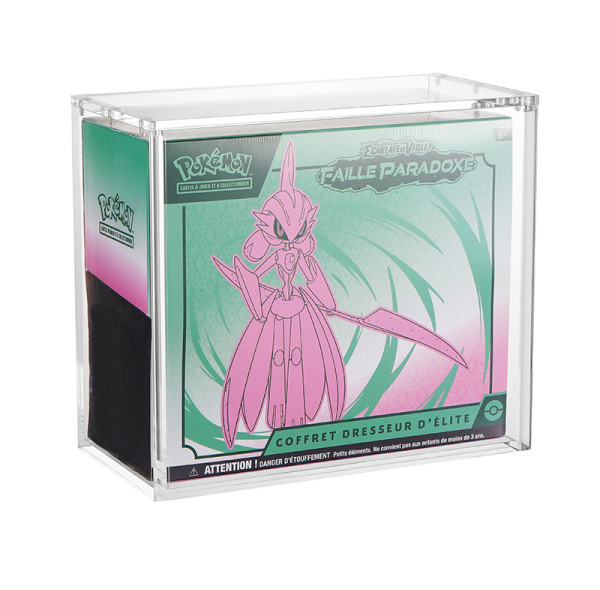
An English-sized premium case with UV-resistant panels shows the deeper footprint that a standard 36-pack carton needs.

Japanese vs English Booster Box Case Dimensions Compared Side by Side
The table below summarises how the two versions behave inside a protective case. Numbers are typical ranges drawn from published product and retailer specs, not a fixed standard, because set-by-set variation is real.
| Attribute | English Booster Box | Japanese Booster Box |
|---|---|---|
| Packs per box | Typically 36 packs | Typically 20 to 30 packs |
| Cards per pack | About 10 cards | About 5 to 7 cards |
| Typical depth | Deeper — roughly 7 to 8 cm | Slim — roughly 3 to 4 cm |
| Typical footprint | About 13 to 14 cm wide | About 14 cm wide |
| Packed weight | Heavier — in the region of 850 g | Lighter — in the region of 290 g |
| Case interior clearance | 1.5 to 3 mm per side | 1.5 to 3 mm per side |
| Base panel need | Thicker floor to resist bowing | Standard floor is usually enough |
| Case interchangability | Not interchangeable with Japanese | Not interchangeable with English |
Compared with brand-name alternatives sold as a single "universal booster box" size, the honest answer is that no one case fits both regions well. Wall thickness, edge polish and lid fit decide quality within a size class; the size itself has to be region-correct first.
How to Measure a Booster Box Before Ordering
A five-minute measurement routine prevents the majority of returns. Do it on a flat surface, with the box in the orientation it will sit on a shelf.
- Measure width, height and depth of the sealed box with a rigid rule, using the outer carton surfaces, not the printed artwork edge.
- Add 1.5 to 3 mm clearance per side so the box slides in without scraping the wrap but cannot rattle.
- Check the lid and board thickness at the top edge, since that is where a tight case pinches.
- Weigh the box. A heavier English carton needs a thicker base panel; a light Japanese box usually does not.
- Note the closure style you want — slide-out tray, drop-over sleeve, or magnetic front — because it changes the internal height allowance.
Then send those numbers to your supplier as a dimensioned drawing request, and confirm with a physical sample holding your own box. A supplier that can only quote an off-the-shelf dimension is not tooled for the mixed-language catalogue an importer actually carries.
Japanese booster boxes from different lines share a slim profile, which is why a region-specific case fits several sets at once.

Region-Specific Fit Rules for Common TCG Lines
The same regional logic runs across the major card games, so a buyer can generalise the rule even though exact dimensions change set to set.
- Pokémon: English 36-pack and Japanese 30-pack boxes are the clearest case of the depth gap. Special and half-box formats from the Japanese line are slimmer again and often need their own tooling.
- One Piece: the Japanese-edition booster boxes are widely imported into Western collector channels, and they follow the slim Japanese profile rather than the deeper Western carton.
- Yu-Gi-Oh! and Magic: The Gathering: regional print runs again shift box depth, so measure each line rather than assuming a shared size.
- Sports and non-TCG sealed: box shapes here vary by manufacturer and year, so the measure-the-box rule applies with even more force.
For a shop that stocks a blend of these lines, the practical approach is a small matrix of two or three case sizes — English-deep, Japanese-slim, and one compact format — rather than a single universal case. If you need branded, colourful options, a magnetic-front OEM programme lets you print a retail-facing logo on the correct-sized body instead of settling for a generic fit.
Region matters across every line: this Japanese-edition One Piece booster box case follows the slim carton profile, not the deeper Western box.

Storing Mixed-Language Collections Together
Retailers and serious collectors often hold both regions side by side, and that raises questions a single case spec cannot answer. Depth differences mean English boxes consume more shelf space per unit, so store them on their own run or on a deeper shelf, and keep the slim Japanese boxes together where a shorter footprint will not leave gaps that invite tipping.
Display-height alignment matters too. Mixing a tall slim Japanese box beside a shorter, deeper English box can leave one case leaning against the other. Use consistent case orientation and even spacing, and keep heavier English cartons on the lower runs where a fall is less costly. For long-term storage, a stable room and a flat, level shelf beat wire racking, which concentrates pressure on a few contact points and can craze acrylic over time.
On the handling side, the routine is the same for both regions: wipe cases with a dry microfibre cloth, avoid alcohol or ammonia cleaners that cloud acrylic, and remove any transit film before display. Photograph high-value pieces on intake so condition disputes are documented, and rotate stock on a fixed schedule so no box sits in one spot for a year.
Wholesale and Retail Notes for Buyers (MOQ, Packaging, Lead Time)
Because booster box cases are bulky, low-density goods, landed cost depends as much on packing and freight as on unit price. Plan around four practical numbers.
- MOQ: custom acrylic booster box case programmes typically start at around 100 pieces per design, which keeps two-size tooling — English and Japanese — viable for small and mid-size importers.
- Packaging: every acrylic unit should ship with a protective film on both faces plus foam or EPE corner sets, then a five-layer master carton. Ask for the carton dimensions and units per carton, because that number drives your freight calculation.
- Lead time: express air freight with DHL, FedEx or UPS typically runs 5 to 12 days, while sea freight is normally 25 to 35 days port to port. For repeat programmes, a small air shipment to launch plus sea for the bulk usually protects the retail date.
- Quality control: specify full batch inspection on acrylic — edge polish, wall thickness, lid fit and clarity — against a golden sample, and confirm internal dimensions on the first production units.
The commercial case for a region-correct fit is straightforward. A case that suits the box protects sealed value, photographs well for e-commerce, and reduces returns, which are expensive in bulky goods. A fleet of cases that half-fit wastes shelf footprint and generates the exact damage claims the buyer was trying to avoid. For context on the category, market research firms place the physical trading card game market in the region of US$9 billion for 2026 with the sealed-product and grading segments growing faster than the base market — an industry estimate that frames why protective packaging demand keeps rising, not a precise forecast for any catalogue line.
About GUARD TCG
GUARD TCG is a protective-packaging manufacturer founded in 2009, supplying trading card accessories and display solutions from our own factory. We produce more than 300 million pieces a year and serve over 10,000 customers in 70-plus countries, including more than 500 distributors. Our range covers acrylic display cases, card binders, sleeves, toploaders, rigid protectors, storage boxes and carrying cases, with OEM and ODM programmes for buyers who need custom dimensions, colours or branding. Every order runs through full batch inspection before dispatch, and we support both express air freight (DHL, FedEx, UPS, typically 5 to 12 days) and sea freight (25 to 35 days). Custom display programmes generally start at an MOQ of 100 pieces.
FAQ: Japanese vs English Booster Box Cases
Q1: Can one acrylic case fit both Japanese and English booster boxes?
No. The depth difference is too large. An English 36-pack box is meaningfully deeper than a slim Japanese box, so a single universal size either will not accept one of them or leaves too much slack for the other.
Q2: How much clearance should a booster box case have?
About 1.5 to 3 mm per side is the usual target. That lets the box slide in without scraping the sealed wrap while keeping it tight enough not to rattle.
Q3: Do I need a thicker base for an English booster box?
Usually yes. Heavier English cartons put more load on the floor panel, so a thicker base resists bowing over months of display, while a light Japanese box can use a standard base.
Q4: What is the MOQ for a custom booster box case in two sizes?
Custom acrylic display programmes commonly start around 100 pieces per design, so a two-size English-and-Japanese programme is realistic for small and mid-size importers.
Q5: Are Japanese special or half boxes different again?
Yes. Compact Japanese formats such as half boxes and special boxes are slimmer than the standard Japanese booster box and often need their own tooling rather than sharing the standard Japanese case.
Conclusion
The rule for buying booster box cases is simple: measure the box, not the product line. Japanese and English booster boxes share a similar footprint but diverge in depth, weight and lid thickness, and those differences decide whether a case protects sealed inventory or quietly damages it. For importers, distributors and retailers the checklist is short — record width, height and depth for every regional version you stock, allow 1.5 to 3 mm per side, match base thickness to weight, and confirm the fit with a golden sample before a container order. Talk to GUARD TCG about custom acrylic cases, or review our acrylic display cases and showcase boxes range and our OEM/ODM programme for region-specific tooling. Our guide to the best acrylic display cases for Pokemon ETBs in 2026 shows how box formats differ across the line, and you can send your box dimensions through the inquiry form for a matched quote.