Pokemon UPC Display Cases: How to Protect Ultra Premium Collections
Pokemon UPC Display Cases: How to Protect Ultra Premium Collections
A Pokemon UPC display case is a rigid acrylic enclosure sized to hold the Ultra Premium Collection box upright while blocking dust, fingerprints, and everyday knocks. Because UPC boxes are unusually tall and heavy, the case must match the exact box dimensions rather than a generic booster box size. For retailers, importers and distributors, the practical payoff is simple: a fitted acrylic showcase keeps sealed inventory crisp for grading, resale or shelf display without altering the product inside, and it turns slow-moving premium stock into merchandise that a customer can actually see.
Why a Sealed Pokemon UPC Needs a Dedicated Display Case
Ultra Premium Collection boxes sit in an awkward middle ground. They are too large to live in a card binder, too valuable to stack loose on a warehouse shelf, and too visually impressive to hide in a plain cardboard carton. TPCi has consistently positioned the UPC line as a premium, low-volume product, and the secondary market prices that scarcity into the box. A sealed UPC that arrives with a crushed corner or a scuffed front panel loses a meaningful slice of its value before it is even opened.
That is why dedicated protection matters more here than for a standard booster box. A generic acrylic case built for a 36-pack booster display will not fit a UPC: the UPC is longer, flatter and heavier, so it either will not seat correctly or it slides and flexes inside the enclosure — a case that looks protective but lets the box shift every time the shelf is bumped.
At wholesale scale the same logic applies: premium sealed product moves from a distribution centre to a retail floor, or onto a trade-show table where dozens of people handle stock in a day. A fitted case is part of the packaging strategy for high-value inventory, not decoration.
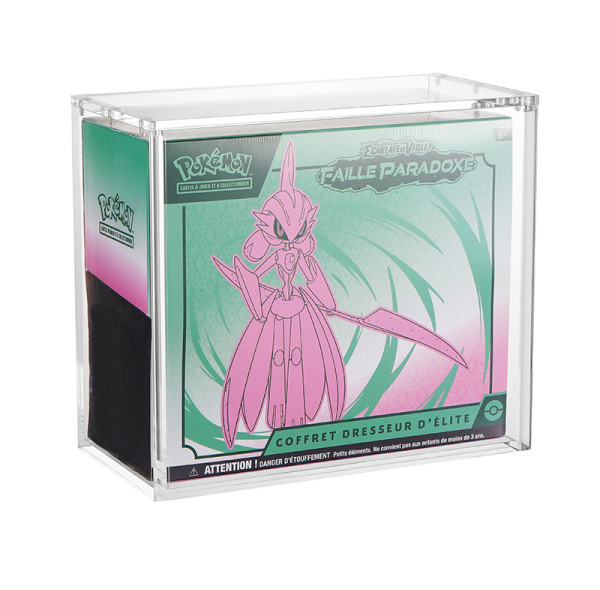
A fitted, retail-ready showcase that keeps a tall sealed box upright and dust-free — the format buyers should match to the exact carton they stock.

What a Pokemon UPC Display Case Actually Protects Against
Protection claims are easy to make and hard to verify, so it helps to separate what acrylic genuinely stops from what it does not.
- Mechanical damage: corner dings, shelf rash, and the small creases that come from sliding a heavy box across a counter. A rigid case absorbs most of this because the impact lands on the acrylic, not the printed board.
- Dust and handling oils: fingerprints and household dust are the two most common causes of a dulled, "aged" look on sealed product. A closed case keeps bare hands off the wrap.
- UV exposure: acrylic with a UV inhibitor slows fading of the printed artwork, which matters for boxes that sit near windows or under retail lighting for months.
- Moisture swings: a closed case moderates, but does not eliminate, humidity cycling. It is not a substitute for a climate-controlled room.
What a case does not do is authenticate a box or guarantee a grade. It preserves condition; it does not create it.
Acrylic Showcase vs. Open Shelf Storage Compared
The alternative to a fitted case is almost always an open shelf, a cardboard master carton, or a generic plastic storage bin. Each option trades cost against protection, and the right answer depends on how long the box will sit and who will handle it.
| Protection Factor | Fitted Acrylic UPC Case | Open Retail Shelf | Cardboard Master Carton |
|---|---|---|---|
| Corner and edge protection | High — rigid walls take the impact | Very low — direct contact risk | Moderate until the carton is bent |
| Dust and fingerprint control | High — fully enclosed | None — open to air and hands | Good while sealed, lost once opened |
| UV resistance | Available with UV inhibitor | None | None |
| Display and merchandising value | Very high — retail-ready | High but unprotected | Zero — hidden in stock |
| Stackability | Good — flat, square footprints | Limited by box shape | Good for storage, poor for display |
| Handling cost at trade shows | Low — one item to carry and wipe | High — constant repacking | Medium — unpack and repack each day |
| Typical use case | Sealed premium stock, VIP display | Fast-sell volume product | Bulk storage and transit |
Compared with brand-name alternatives, the difference between a well-made case and a cheap one is mostly wall thickness, edge polish and lid fit rather than the material itself — the parts buyers should inspect in a sample before a container order.
A closed acrylic showcase keeps dust and handling oils off the box face, which is exactly what preserves the crisp look buyers pay for.

How to Choose: Sizing a Case for the Ultra Premium Collection Box
Sizing is where most display case problems start, so treat these dimensions as the first filter when you audit a supplier. UPC boxes are not one uniform size: published specs for recent North American UPCs cluster around roughly 3.25 to 3.6 inches deep, 8.5 inches tall and 12.5 to 14.6 inches long, with a packed weight near 2.7 to 2.9 lbs. Smaller regional variants exist, and Pokémon has also shipped premium collection formats such as the Super-Premium Collection that use different proportions again.
A well-specified case therefore follows three rules:
- Internal clearance of 1.5 to 3 mm per side. Enough to slide the box in without scraping the print, tight enough that it cannot rattle.
- Base thickness matched to weight. A box near three pounds needs a thicker floor panel than a light ETB, otherwise the base bows over time.
- Height that clears the lid without pressure. The case should close on the lid, not on the box top.
When you evaluate display case manufacturers, ask for a dimensioned drawing and a physical sample with your own box inside it. A supplier that can only quote a generic size is not set up for this segment. Buyers who need branded options should also look at colorful magnetic cases OEM programmes, because a magnetic front panel allows a retail-facing logo that a plain slide-top cannot.
Smaller regional box formats need their own tooling — a case built for one carton size will not seat another cleanly.

Slide-Out Trays, Magnets, and Lid Styles Explained
Three closure styles cover almost every requirement, and each suits a different buyer.
| Style | How It Works | Best For | Consideration |
|---|---|---|---|
| Slide-out tray | Box rests on a tray that slides out of a sleeve | Frequent handling, trade shows | Tray clearance must stay tight |
| Magnetic lid | Front or top panel held by embedded magnets | Retail display, branded fronts | Higher unit cost |
| Stacked lid | Sleeve drops over a base | Storage and stacking | Must be lifted fully to access |
| UV-filter upgrade | Additive in the panel slows fading | Window-facing or lit displays | Slight clarity trade-off |
| Engraved base | Laser-etched nameplate area | Corporate gifting, event pieces | Adds lead time |
| Stackable interlock | Moulded feet that seat into the unit below | Retail floor towers, storage rooms | Requires consistent tooling |
Note one terminology trap that trips up new buyers: a magnetic display case is not the same product as a magnetic one-touch card holder. The first is a box-sized showcase; the second is a rigid holder for a single raw card. Mixing the two in a purchase order is a common source of returns. If a customer's need is really single-card protection, a toploader or a booster pack toploader is the correct line, not a display case.
Premium collection formats are not one uniform size; a case matched to the specific box, like this Super-Premium Collection showcase, avoids rattle and print scraping.

Common Mistakes That Damage a Sealed UPC
Even with the right case, a handful of handling errors quietly cost buyers money.
- Storing the box on its long edge. Pressure migrates to one panel and can bow the sealed wrap over months.
- Stacking cases more than the structure allows. Acrylic is strong in compression but will craze under uneven point loads.
- Cleaning with alcohol or ammonia sprays. Solvent cleaners cloud acrylic and can attack printed surfaces through the vents.
- Leaving the protective film on. It is a transit film, not a display finish, and it yellows.
- Assuming a case means the item is graded. It is protective packaging, not certification.
Best practice is a simple routine: display upright, clean with a lint-free microfibre cloth and mild soap solution, and rotate stock on a fixed schedule so nothing sits in one spot for a year.
How to Store and Maintain a UPC Inside Acrylic
Once a sealed box is in a fitted case, maintenance is minimal. Wipe the exterior weekly with a dry microfibre cloth; use a damp cloth only for sticky residues and dry immediately. For long-term storage, place the cased box on a flat, level surface rather than wire racking, which concentrates pressure on a few contact points.
Retailers who cycle display stock should photograph each high-value piece on intake. The photo record supports condition disputes and doubles as an online listing image.
Light, Heat, and Placement: Where Not to Display It
The three placement killers are direct sun, heat sources and humid rooms. Direct sun fades artwork even behind a UV-filtered panel, because UV filtering reduces rather than removes the effect. Radiators and server closets create temperature swings that stress the sealed wrap, while basements and unventilated storerooms push humidity high enough to soften board and encourage mould.
A practical target for premium sealed inventory is a stable room near 18 to 22 degrees Celsius with relative humidity in the 45 to 55 percent band, away from windows and doorways. These are general storage guidelines, not a manufacturer warranty, and should be presented to customers as best practice.
Wholesale and Retail Notes for Buyers (MOQ, Packaging, Lead Time)
Because display cases are bulky, low-density goods, landed cost depends as much on packing and freight as on the unit price. Buyers should plan around four practical numbers.
- MOQ: custom acrylic display case programmes typically start in the region of 100 pieces per design, which keeps tooling and colour matching viable for small and mid-size importers.
- Packaging: every acrylic unit should ship with a protective film on both faces plus a foam or EPE corner set, then a five-layer master carton. Ask for the carton dimensions and units per carton, because that figure drives your freight calculation.
- Lead time: express air freight with DHL, FedEx or UPS typically runs 5 to 12 days, while sea freight is normally 25 to 35 days port to port. For repeat programmes, a mixed approach — a small air shipment to launch, sea for the bulk — usually protects the retail date.
- Quality control: specify full batch inspection on acrylic, checking edge polish, wall thickness, lid fit and clarity against a golden sample.
For retailers, the merchandising question is whether the case earns its shelf space. A cased UPC signals "premium" and is easy to photograph for e-commerce, but it consumes more footprint per unit. The usual answer is to case only the highest-value pieces and keep the case reusable, so it can be re-dressed for the next premium release. Sellers running pop-up stalls and trade shows usually find a fitted, brandable case doubles as a portable display unit and cuts setup time, which is why trade show card display and pokemon vendor display formats increasingly specify a magnetic front panel.
Research and Markets puts the acrylic display case segment at roughly US$796 million in 2026 with mid-single-digit annual growth, an industry estimate that confirms steady demand rather than a precise forecast for any one catalogue line.
About GUARD TCG
GUARD TCG is a protective-packaging manufacturer founded in 2009, supplying trading card accessories and display solutions from our own factory. We produce more than 300 million pieces a year and serve over 10,000 customers in 70-plus countries, including more than 500 distributors. Our range covers acrylic display cases, card binders, sleeves, toploaders, rigid protectors, storage boxes and carrying cases, with OEM and ODM programmes for buyers who need custom dimensions, colours or branding. Every order runs through full batch inspection before dispatch, and we support both express air freight (DHL, FedEx, UPS, typically 5 to 12 days) and sea freight (25 to 35 days). Custom display programmes generally start at an MOQ of 100 pieces.
FAQ: Pokemon UPC Display Cases
Q1: Will any booster box acrylic case fit a Pokemon UPC?
No. UPC boxes are longer, flatter and heavier than standard booster displays, so a generic booster box case will not seat them correctly. Ask for a dimensioned drawing matched to the specific UPC you stock.
Q2: Does a case actually keep the sealed box's value?
It preserves condition by preventing corner damage, dust and handling marks, which is what buyers pay a premium for in sealed product. It does not authenticate a box or guarantee a future price.
Q3: Is a magnetic case better than a slide-out tray?
They solve different problems. Magnetic fronts are better for retail display and branding; slide-out trays are better for frequent handling at shows. Neither is universally superior.
Q4: What is the MOQ for a custom Pokemon display case?
Custom acrylic display programmes commonly start around 100 pieces per design, which covers tooling, colour matching and branded front panels.
Q5: Can I stack cased UPC boxes?
Light stacking on a flat surface is normally fine, but keep loads even and avoid wire racking or tall unsupported stacks, which concentrate pressure and can craze the acrylic.
Conclusion
A Pokemon UPC display case is not a generic accessory; it is fit-specific protective packaging for one of the least forgiving box formats in the hobby. Matching the case to the actual box dimensions, choosing the right closure style and handling the cased box sensibly will protect sealed value far better than an open shelf or a cardboard carton. For importers, distributors and retailers, the buying checklist is short: verified internal dimensions, wall and base thickness matched to weight, a reusable brandable design, clear MOQ and packaging data, and a supplier who provides a golden sample and full batch inspection. Talk to GUARD TCG about custom acrylic cases and magnetic-front OEM designs, or review our acrylic display cases and showcase boxes range and our OEM/ODM programme before your next order. Our guide to the best acrylic display cases for Pokemon ETBs in 2026 shows how box formats differ across the line, and you can send your box dimensions through the inquiry form for a matched quote.