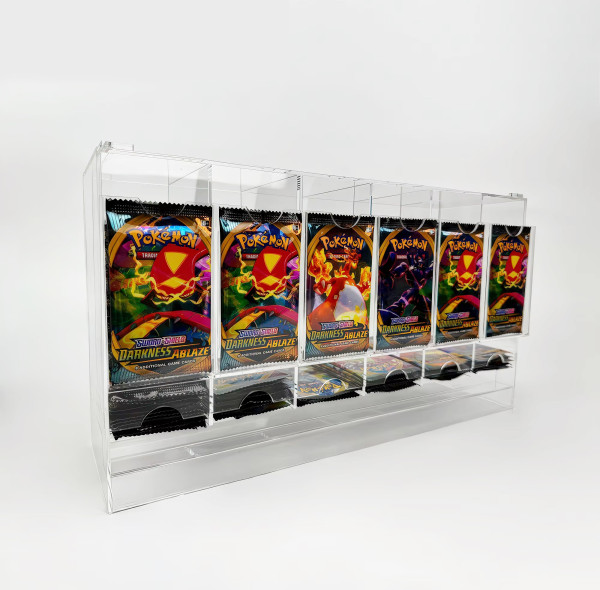
QC in Card Accessory Manufacturing: What Quality Checks Actually Matter
QC in Card Accessory Manufacturing: What Quality Checks Actually Matter
Short answer: five checks decide whether a shipment of card accessories is good or garbage — dimensional tolerance, material thickness and grade, print colour and registration, edge/seam finish and open-close durability, and packing integrity. Run them with AQL sampling (ISO 2859-1) through production plus 100% inspection on the features a collector feels in the hand, and you catch virtually every defect that turns into a return. Everything else on a typical inspection checklist is paperwork.
This guide is written for importers, distributors, and store owners buying card sleeves, toploaders, magnetic holders, binders, and display cases at volume. It walks through the five checkpoints with the numbers we use on our own lines, the difference between sample inspection and full inspection, the defects that show up most often, and how to verify quality before you release a payment. If you want the short version of what we build and how we test it, start with our trading card accessories catalog.
What Is Quality Control in Card Accessory Manufacturing?
Quality control (QC) in this industry means measuring the physical output of a production line against a written specification, then deciding accept, rework, or reject. It is not the same as quality assurance (QA), which is the system that prevents defects in the first place — material selection, tooling maintenance, operator training, and documented work instructions.
Card accessories are unforgiving to buy on trust because the product is thin, clear, and cheap per unit. A 2 mm error in a sleeve's width makes it unusable; a 5% haze difference makes an acrylic case look cloudy in a retail window; a slightly proud weld seam scratches the very card the holder was bought to protect. None of those defects show up in a product photo or a spec sheet. They show up in the buyer's hands, after the container has sailed.
The Five QC Checkpoints That Actually Matter
Across every accessory category we produce, the same five checkpoints carry almost all of the quality risk. Each one has a measurable number attached, and each one maps to a customer complaint you would otherwise receive three months later.
- Dimensional tolerance. Sleeve width and height, pocket pitch in binders, internal cavity of toploaders and magnetic holders, lid-to-base fit on boxes. Our standard tolerance is ±0.3 mm on cut sleeve dimensions, ±0.5 mm on moulded and folded parts, and ±5% on pocket pitch across a full page. A standard penny-style sleeve at 66×91 mm that measures 66.8 mm wide will not slide cleanly into a binder pocket with cards already loaded — and that is a return.
- Material thickness and grade. Sleeves are specified in microns; rigid holders in PT (thousandths of an inch) or millimetres. We run 50 micron clear sleeves as a baseline, with 60, 80, and 100 micron options, and standard 35PT toploaders for trading cards. Thickness is verified with a digital micrometer at multiple points per piece, because film gauge drifts along the extrusion direction.
- Print colour and registration. For printed, holographic, and art sleeves, we check colour difference with a spectrophotometer and a ΔE tolerance, plus registration accuracy on multi-colour artwork. ΔE ≤ 2 is a normal commercial target; anything above 3 is visible side by side on a shelf.
- Edge and seam finish, plus open-close durability. Burrs, jagged die-cut edges, uneven welds, and weak magnetic closures are the defects collectors notice immediately. We inspect edges under magnification and cycle-test box hinges, magnetic holders, and binder rings to a written minimum before sign-off.
- Packing integrity and count accuracy. Inner poly bag seal strength, carton drop and compression performance, and — the one that causes the loudest arguments — actual piece count versus the label. Every export carton is weighed as a cross-check on count accuracy.
Card Accessory QC Standards: What Good Looks Like
The table below is the working standard on our production lines. Treat the numbers as the level a competent factory should be able to hit consistently, not as the theoretical best case. Values marked as industry estimates are typical market practice rather than a published standard.
| Checkpoint | What We Measure | Working Standard | Why It Matters |
|---|---|---|---|
| Dimensional tolerance | Sleeve W×H, cavity size, pocket pitch | ±0.3 mm cut film; ±0.5 mm moulded; ±5% pitch | Off-size sleeves jam binders and holders |
| Thickness / gauge | Microns on film; PT or mm on rigid parts | 50 micron baseline; 35PT toploader | Thin film tears at corners under load |
| Clarity / haze | Light transmittance and haze on clear film and acrylic | High clarity, low haze (measured per ASTM D1003 practice) | Hazy plastic looks cheap in a retail display |
| Colour difference | Printed and holographic sleeves vs. approved sample | ΔE ≤ 2 target; > 3 reject | Batch-to-batch colour shifts break sets |
| Edge / seam quality | Burrs, weld uniformity, trimmed corners | No sharp or proud edges under 10× magnification | Rough edges scratch cards and fingers |
| Open-close durability | Hinge cycles, magnet pull, ring mechanism | Cycle-tested to agreed minimum before release | Weak closures fail within weeks of use |
| Packing and count | Seal strength, drop/compression, piece count | Carton weight verified against label count | Short counts and crushed cartons end accounts |

Clear and matte retail sleeves are measured for gauge and clarity off the line — haze and micron drift are the two defects buyers complain about most often.
Sample Inspection vs. 100% Inspection: Which Do You Need?
Most importers assume they must choose one. In practice the answer is both, applied to different features.
Sampling inspection follows ISO 2859-1 (widely used in its ANSI/ASQ Z1.4 form in North America). You define a lot size, an inspection level, and an AQL — for consumer card accessories, a critical-defect AQL of 0 and a major-defect AQL of 1.5 or 2.5 is normal commercial practice. A random sample is drawn, defects are counted, and the lot is accepted or rejected on the numbers. It is fast, statistically defensible, and cheap.
100% inspection is reserved for features where a single failure is unacceptable: printed brand sleeves in a retail-ready pack, magnetic holder magnets and latches, and any product carrying a customer's own logo. On our lines, printed and magnetic items are checked piece by piece before packing; plain clear sleeves and standard toploaders run on AQL sampling with in-line gauge checks every production hour.
The practical rule for importers: sample for the bulk, inspect 100% for anything printed, magnetic, or logo-bearing.

Custom pull-tab sleeves are cut and welded to order — width tolerance and weld uniformity are checked lot by lot against the approved golden sample.
The Most Common Defects in Card Sleeves and Holders
After more than fifteen years of producing card accessories, the same defect list keeps reappearing across factories in the category. If a supplier tells you their line has no rejection rate, they are not measuring.
- Burrs and rough die-cut edges. Usually caused by a worn die or a mis-set cutting pressure. The card catches on the edge as it slides in, and corners fray within a handful of insertions.
- Colour difference between batches. Ink viscosity, film supplier changes, and press temperature produce visible shifts on printed sleeves. This is the defect that breaks art sleeves and holographic lines, because collectors compare batches side by side.
- Oversized or undersized sleeves. Film expands and contracts with ambient temperature and humidity in the converting hall. A sleeve cut in a cold morning shift can measure a millimetre differently from one cut in the afternoon — and pocket fit suffers.
- Over-tight card pockets in binders. Slightly small pockets feel secure in QC but tear cards or refuse double-sleeved cards in the customer's hands. Pocket pitch tolerance catches this before packing.
- Haze and cloudiness in clear parts. Recycled regrind used beyond its intended ratio is the usual culprit, and it is invisible in a spec sheet. It is visible the moment a shop owner holds the case under lighting.
- Weak magnetic closures and loose hinges. Magnet strength varies between suppliers; a holder that opens in transit destroys the card it protects. Cycle testing and magnet pull measurement prevent this class of failure.

Printed and holographic art sleeves are the highest-risk category: registration accuracy and ΔE colour tolerance are checked against the signed-off sample before every run.
How to Verify Quality Before You Pay for a Shipment
You do not need a factory in your own country to get reliable quality; you need an inspection plan that costs less than the risk it removes. Four steps cover the great majority of failure modes.
1. Agree a written specification and a golden sample. Every dimension, micron value, colour reference, and closure requirement should exist in writing, with a physical approved sample kept by both sides. An order that exists only as a product photo is an order you cannot police.
2. Commission a pre-shipment inspection. Third-party inspection firms — SGS, Bureau Veritas, Intertek, and QIMA are the names most importers use — will attend the factory, pull an AQL sample, and issue a report with photographs. Book it when the order is at least 80% packed and fully packed at the time of the visit.
3. Ask for live video inspection. For repeat orders, a scheduled video call where a camera follows a random unopened carton from seal to count to dimensional check is often more informative than a paper report, and it costs nothing. We run these routinely for importers and distributors.
4. Test the product as the end customer will. Load real cards into the sleeves. Load double-sleeved cards into the binder pockets. Drop a packed carton from carton height. Cycle the magnetic holder. Ten minutes of hostile testing at sample stage prevents an entire container of returns.
Material compliance sits alongside these steps rather than inside them. Card accessories destined for the EU and North America should be able to produce test documentation for substances restricted under REACH and, where toys or children's products are plausible, EN 71-3 heavy metal migration limits. Ask for reports tied to your actual order — not a generic certificate that could refer to any product.

Submission-grade semi-rigid holders live or die on cavity tolerance and edge finish — a burr here damages high-value cards in transit to a grading company.
Red Flags When Auditing a Card Accessory Factory
Most quality disasters are visible before the first order. When you visit — or video-audit — a supplier, treat these as disqualifying rather than negotiable.
- No written inspection standard, or a standard that contains only the words “high quality”.
- No golden sample archive, so nobody can prove what was approved six months ago.
- No measuring equipment on the line — a factory without a micrometer or a thickness gauge is not measuring anything.
- Defect data that exists only in a supervisor's memory; ask for a rejection rate by defect type and watch the answer change.
- Ink, film, or magnets swapped to cheaper suppliers mid-order without notification, which is the single most common cause of colour and closure failures.
- Reluctance to allow third-party inspection or scheduled video checks.
Best Practices for Building QC Into a Custom Order
Quality is cheapest when it is designed into the order, not inspected in at the end. Five practices do most of the work.
- Write the spec around what the customer feels. Specify sleeve width, thickness, edge finish, and closure force — not just “clear sleeves”.
- Freeze the golden sample. Both sides keep a signed, dated sample. Every production run is compared against it, not against the previous run.
- State your AQL up front. Critical 0, major 1.5–2.5 on consumer accessories, and 100% inspection on printed or logo-bearing items.
- Plan the pre-shipment inspection into the schedule. Retesting is what protects your launch date, not optimism.
- Review defect data after every order. A supplier that reports, trends, and closes defects is doing QA; one that only reports compliance is doing paperwork.
- Keep a retention sample per shipment. When a customer complains eight months later, the retained sample settles the question in minutes.

Holographic and laser finishes need surface inspection under directional light — scuffs and coating skips are invisible under diffuse lighting and obvious under a shop's spotlights.
About GUARD TCG
GUARD TCG is the trading card accessories division of a factory established in 2009. We produce more than 300 million pieces a year for customers in over 70 countries, serving more than 10,000 customers and 500+ distributors, with OEM and ODM programs for brands, distributors, and retail chains. Our QC process combines AQL sampling per ISO 2859-1 during production with full batch inspection on printed, magnetic, and logo-bearing items, plus dimensional and gauge checks every production hour. Standard items start at a 100-piece MOQ; custom print and tooling programs are quoted individually. Shipments move by DHL, FedEx, or UPS in 5–12 days, or by sea in 25–35 days. You can see current products in the card accessories catalog, read more about our factory and quality process, or contact our team to request a QC checklist for your next order.
FAQ
Q1: What tolerance is acceptable on card sleeves?
For cut film sleeves, ±0.3 mm on width and height is a reasonable commercial standard, with ±0.5 mm acceptable on moulded or folded rigid holders. Anything beyond that starts to affect binder pocket fit and double-sleeving. Always specify the tolerance in writing before production, because “standard size” means different things to different factories.
Q2: What is a normal AQL for card accessories?
Common practice is critical defects at AQL 0, major defects at AQL 1.5 or 2.5, and minor defects at 4.0, applied under ISO 2859-1 or its ANSI/ASQ Z1.4 equivalent. Printed or logo-bearing products should additionally be inspected 100% before packing.
Q3: Is 50 micron a good thickness for card sleeves?
50 micron is the workhorse gauge for penny-style and inner sleeves. Thicker film — 60 to 100 micron — adds durability and a premium feel for retail-pack sleeves and deck sleeves, while inner "perfect fit" sleeves are typically thinner because they sit inside another sleeve. Choose by use case, not by the biggest number.
Q4: How do I check quality if I cannot visit the factory?
Use a third-party pre-shipment inspection from a firm such as SGS, Bureau Veritas, Intertek, or QIMA, and ask your supplier for a live video inspection that follows a random carton from seal to count to measurement. Both are inexpensive relative to the cost of receiving a defective container.
Q5: What causes colour differences between sleeve batches?
Ink viscosity changes, press temperature, and undisclosed film supplier switches. The fix is a signed golden sample, a ΔE colour tolerance of 2 or better, and a rule that any material substitution must be approved in writing before production.
Conclusion
QC in card accessory manufacturing comes down to five measurable things: dimensional tolerance, thickness and material grade, colour and print registration, edge and closure quality, and packing integrity — verified with AQL sampling through production and 100% inspection on printed, magnetic, and logo-bearing items. Everything else is supporting documentation. If you are sourcing card accessories and want the same checklist our own production lines run on, send us your specification and we will match it to a tested product.