Shipping Card Accessories Internationally: Air vs. Sea Freight Costs and Timing
Shipping Card Accessories Internationally: Air vs. Sea Freight Costs and Timing
For most card accessories importers, the fastest answer is this: send small, urgent orders and samples by express courier (DHL, FedEx or UPS) in 5-12 days, move large production orders by sea freight in 25-35 days for roughly 60% or more in freight savings per unit, and split mixed orders between the two. The right choice depends on your order volume, your restock deadline and how much of your landed cost you can tie up in inventory. As a card accessory manufacturer shipping to 70+ countries since 2009, GUARD TCG has priced out thousands of these shipments — here is how the decision actually works.
What Are the Main Ways to Ship Card Accessories Internationally?
Card accessories — sleeves, toploaders, rigid slabs, binders, deck boxes and acrylic display cases — are bulky, lightweight and low-value per kilogram. That combination flips normal freight logic upside down: you are almost never limited by weight, you are limited by volume. There are four practical modes, and each one behaves very differently for this product category.
- Express courier (DHL / FedEx / UPS): door-to-door parcel service, typically 5-12 days from China, priced per kilogram with a volumetric weight divisor of 5000 (cm³ per kg).
- Air freight (consolidated): 7-12 days airport-to-airport plus clearance, usually cheaper than express per kg but requiring your own customs broker and final-mile arrangement.
- Sea freight LCL (less than container load): 25-35 days port-to-port, cost-efficient from roughly 3-8 cubic meters, but you share a container and pay CFS fees at both ends.
- Sea freight FCL (full container load): 25-35 days port-to-port, the lowest landed cost above roughly 15-20 cubic meters, with a 20ft container holding about 28-33 cubic meters of sleeved or boxed accessories.
Why Your Shipping Choice Changes Your Whole Business Case
Freight is a margin decision before it is a logistics decision. Two importers can buy the same custom card sleeves at the same FOB price and end up with completely different unit costs, because freight, duty and inventory carrying cost sit on top of the FOB price.
- Cash flow: sea freight adds 25-35 days of transit to your payment terms; you buy inventory two months before you can sell it.
- Restock speed: express couriers are the only realistic option when a retail account runs dry mid-season.
- Damage risk: rigid slabs and acrylic cases are crack-prone; every extra handling step (LCL consolidation especially) adds risk.
- Minimum order economics: our standard accessories start at just 100 pieces, which is small enough that express shipping often beats booking an LCL shipment for a first sample order.

Storage-style outer cartons like this toploader storage box are the ideal freight unit: rigid, stackable and mostly air, which is exactly why volumetric weight dominates your quote.
Air Express vs. Air Freight vs. Sea Freight: Cost and Timing Compared
The table below reflects the ranges we quote and see most often for card accessories leaving China. Treat the numbers as industry estimates — fuel surcharges, peak season and route capacity move them week to week, and Freightos has documented air cargo rates swinging anywhere from $2.50 to $8.00 per kilogram since 2020.
| Feature | Express Courier | Air Freight | Sea Freight (LCL / FCL) |
|---|---|---|---|
| Typical transit time | 5-12 days door-to-door | 7-12 days airport-to-airport | 25-35 days port-to-port |
| Relative cost per kg | Highest — roughly 3-5x sea | Moderate — roughly 2-3x sea | Lowest baseline per unit |
| Best order size | Samples to ~1 CBM / 200 kg | ~1-3 CBM, deadline-driven | LCL from ~3 CBM, FCL from ~15 CBM |
| Volumetric divisor | 5000 (cm³ per kg) | 6000 (cm³ per kg), carrier-dependent | Charged on CBM, not weight |
| Who handles customs | Courier clears and bills you | You appoint a broker | You or your forwarder |
| Damage risk | Low — fewest handling points | Low to moderate | Moderate — consolidation adds handling |
| Best for card accessories | New product samples, urgent reorders | Launch deadlines, mid-size restocks | Container-scale binder, box and case programs |
How to Estimate Freight Cost: Volumetric Weight vs. Actual Weight
This is the single most misunderstood part of shipping low-density accessories. Couriers and airlines charge whichever is greater: the actual weight on the scale, or the volumetric (dimensional) weight calculated from the carton size.
The standard formula is length × width × height in centimetres, divided by a carrier divisor — 5000 for most express services and 6000 for many air freight lanes. A carton measuring 60 × 40 × 40 cm that weighs only 10 kg becomes a 19.2 kg chargeable shipment at a 5000 divisor. That is nearly double the physical weight, and it is why a 20 kg box of sleeves can cost as much to fly as a 40 kg box of dense goods.
Practical consequence: for air and express shipments, ask your supplier to compress cartons and avoid oversized masters. For sea freight, the same logic applies to CBM — you pay for the space, so reducing empty volume is the single biggest lever on your landed cost. A quick estimate you can run yourself: (carton CBM × rate per CBM) + origin charges + destination THC + duty = landed freight cost. Ocean rates are also built from a base rate plus Bunker Adjustment Factor, Currency Adjustment Factor and Terminal Handling Charges, as Freightos documents in its ocean freight guide.
How to Choose the Right Shipping Method for Your Order
Match the mode to the job, not to habit. A three-question filter usually decides it in under a minute:
- Is the deadline inside 30 days? If yes, sea freight is out unless the goods already shipped.
- Is the shipment under about 1 CBM or 200 kg? If yes, express courier is almost always cheaper than air freight once you count broker fees and final-mile costs.
- Can the volume fill 15 CBM or more per month? If yes, build a shipping calendar around FCL sailings and use express only for exceptions.
Many of our distributor customers run a hybrid program: two or three FCL or LCL shipments per year for core stock, with express top-ups when a specific SKU sells faster than forecast. That combination typically delivers the best average cost while keeping shelves full.
Packaging and Customs Documentation Essentials
Card accessories are straightforward to ship but easy to mis-declare, and a vague description is the most common cause of customs delays. Describe exactly what the goods are, with material and use.
- Flexible plastic sleeves and protective films are usually classified in plastics heading 3926.90, or 3923.21 when they are bags of polymers of ethylene — your broker confirms the final code.
- Rigid slabs and acrylic display cases typically fall under plastic articles in 3926, with 3926.40 covering similar decorative or display items.
- Binders and album covers are often classified in paper and board heading 4820.30.
- Documents to prepare: commercial invoice, packing list, HS code per line item, country of origin, and a statement of the goods' intended use. Fewer than six product lines per invoice keeps clearance faster.
- Marking: label each master carton with SKU, quantity, net and gross weight, dimensions and the shipping marks your forwarder supplies.

Rigid 35PT ultrasonic-sealed slabs need corner protection inside the master carton — cracking in transit is a handling problem, not a production defect.
Clearance and Last-Mile Delivery After Arrival
Freight quotes stop at the port or airport; your real cost continues to your warehouse. Expect destination terminal handling charges, customs brokerage, duty and value-added tax, plus drayage or parcel delivery to the final address. Express couriers bundle all of this into one invoice, which is a hidden advantage when you are testing a new market: you see your true landed cost per unit immediately.
Two habits avoid most clearance surprises. First, make sure the HS code on the invoice matches the code your broker files — mismatches trigger inspections. Second, pre-clear before the vessel or flight arrives whenever your broker supports it, so cargo moves the day it is released instead of waiting days for paperwork.

Best Practices for Reducing Freight Costs
Once the mode is chosen, cost control comes from the shipment itself rather than the rate negotiation.
- Design cartons for density: flat-packed sleeves travel far cheaper per unit than pre-assembled retail boxes full of air.
- Buy more of fewer SKUs: consolidated SKUs mean fuller cartons and fewer line items on the invoice.
- Book around peak season: Q3 and pre-holiday surcharges hit both air and ocean; shipping in the off-season can save meaningful amounts.
- Use one forwarder per lane: volume discounts and priority space come from loyalty, not from shopping every shipment.
- Keep a mixed program: sea for the bulk, express for exceptions — exactly the model our own outbound logistics uses for shipments to over 10,000 customers worldwide.

Thin perfect-fit inner sleeves ship in dense, flat cartons — the lowest freight cost per unit of anything in a card accessory catalog.

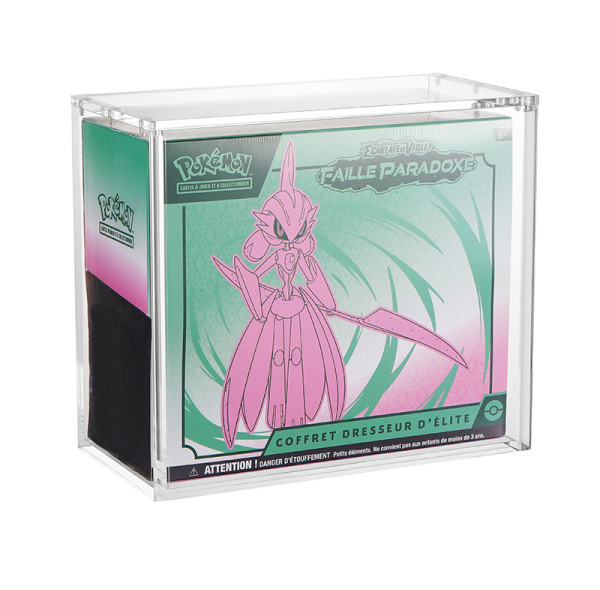
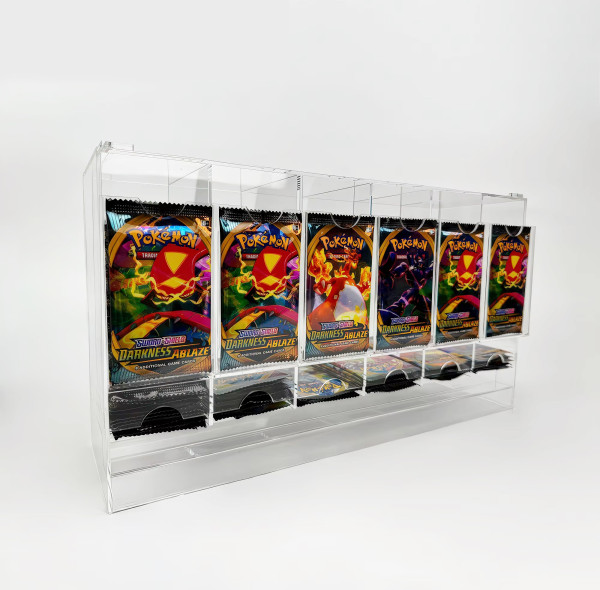
Acrylic display cases are the opposite extreme: light but bulky, so volumetric weight and CBM planning matter most. Browse our full card accessory line to see which SKUs suit which freight mode.

About GUARD TCG
GUARD TCG is a trading card accessory manufacturer established in 2009, producing over 300 million pieces per year for more than 10,000 customers and 500+ distributors across 70+ countries. We run OEM and ODM programs, accept standard-product orders from 100 pieces, quote DHL, FedEx and UPS door-to-door delivery in 5-12 days or sea freight in 25-35 days, and inspect every production batch before it leaves the factory. Because we ship these goods every week, our quotes reflect real carton dimensions and real volumetric weights rather than padded estimates. Start with our factory profile, or send your target volumes through our inquiry form and we will return a freight-inclusive landed-cost estimate.
FAQ
Q1: What is the cheapest way to ship samples from a card accessory factory?
For samples under about 1 CBM or 200 kg, express courier is normally cheapest once you count brokerage and final-mile fees. Freightos notes that express services handle the entire door-to-door journey in under five days for shipments in that size range, and our own sample orders typically land in 5-12 days.
Q2: How much cheaper is sea freight than air freight?
On a per-unit basis, sea freight commonly runs 60% or more below air express for card accessories, because the goods are bulky and low-density. The trade-off is 25-35 days of transit and larger minimum volumes.
Q3: Why is my freight bill higher than the actual weight of the boxes?
Because volumetric weight is being charged. Divide length × width × height in centimetres by 5000 (express) or 6000 (air freight) and compare that figure to the scale weight — carriers bill the higher number.
Q4: What HS code applies to trading card sleeves?
Flexible plastic sleeves are usually classified under plastics heading 3926.90, or 3923.21 for bags of polymers of ethylene, while binders often fall under 4820.30. Confirm the final code with a customs broker before your first shipment.
Q5: Should I use LCL or wait until I can fill a container?
Use LCL from about 3 CBM up to roughly 15 CBM. Below 3 CBM, express is often comparable; above 15-20 CBM, an FCL container usually wins on cost and reduces handling damage risk.
Conclusion
Shipping card accessories internationally comes down to matching mode to volume and deadline: express courier in 5-12 days for samples and urgent restocks, air freight for mid-size shipments on a fixed launch date, and sea freight in 25-35 days for the bulk of your program at 60% or more below air express. Control what you can — compress cartons, plan around volumetric weight, classify goods accurately and pre-clear customs — and the freight line on your landed-cost sheet becomes a competitive advantage rather than a mystery.