Graded Card Wall Displays: Turning Slabs into Store Decor
Graded Card Wall Displays: Turning Slabs into Store Decor
A graded card wall display is a retail wall fixture — usually a UV-filtering acrylic frame, a tiered rail, or an enclosed case — used to hang high-grade slabs where customers see them the moment they walk in. Done properly it does three jobs at once: it decorates the shop, it protects valuable inventory from handling, dust, and UV fade, and it acts as a living advertisement that signals credibility. This guide covers wall patterns, frame selection, lighting, maintenance, and the return on investment behind a slab wall, drawing on GUARD TCG's factory experience supplying display fixtures to card shops worldwide.
What Is a Graded Card Wall Display?
A graded card wall display is any fixed or semi-fixed wall-mounted system that holds encapsulated cards (slabs) in visible, protected positions. The slab itself — the sealed acrylic holder with the label from a grading company such as PSA, Beckett (BGS), or CGC — is the unit being displayed. The "display" is everything around it: the frame, rail, shelf, bracket, back panel, spacer, and lighting that keep that slab upright, readable, and safe.
It is different from a countertop easel or a shelf tray. A wall display is vertical, permanent, and designed to be seen from across the room rather than handled. For a card shop or a serious collector, that vertical real estate is the most valuable display surface in the building — it is where the store's taste, inventory depth, and trustworthiness are communicated before a single word is spoken.
Why a Slab Wall Works: Trust, Discovery, and Social Proof
Graded cards are the most persuasive artifacts a card business owns. Each slab carries an independent, third-party grade and an authenticating label, so a wall of them answers the customer's quiet question — "is this shop serious?" — without any sales pitch. Industry observation consistently shows that visible, high-grade inventory increases dwell time and enquiry rate, because a customer who sees a PSA 10 Charizard or a BGS 9.5 rookie stops, points, and starts a conversation.
- Trust display: slabs are graded by independent companies, so the wall shows verified quality, not marketing claims.
- Discovery surface: a wall exposes inventory that would otherwise sit unseen in a binder or box, creating serendipitous sales.
- Social proof: visitors photograph slab walls; those photos travel to social media and act as free local advertising.
- Brand signal: a clean, well-lit wall communicates organisation and professionalism; a cluttered one signals the opposite.
- Handling reduction: when a card lives in a frame instead of a loose pile, staff and customers touch it less, which reduces accidental damage.
- Cross-sell anchor: wall displays sit naturally beside slab sleeves, bumpers, and storage cases, lifting accessory attach rate.
Wall Layout Patterns: Grid, Single Row, and Themed Zones
The layout question comes before the fixture question. Three patterns cover almost every store and collection, and most serious walls combine two of them.
- Grid / matrix wall: a uniform block of identical frames arranged in rows and columns. Best for a "hall of fame" wall — a trophy case of the store's best grades. Requires identical slab dimensions, so standardise on one brand or one 35PT-compatible frame format.
- Single-row feature rail: one horizontal line of frames at eye level (roughly 140–160 cm from the floor), used as a feature strip. Ideal for retail where the wall must also carry signage and shelving, and it keeps each slab readable without a ladder.
- Themed zones: separate clusters for a game, a set, or a category — for example a Pokémon vintage zone, a modern chase zone, and a sports rookie zone. Zones help customers navigate and help staff tell a story during events or set releases.
A practical hybrid is a themed grid: a matrix wall subdivided into labelled zones, each zone following the same spacing rules. Consistency of frame size and gap is what makes a wall look intentional rather than improvised.
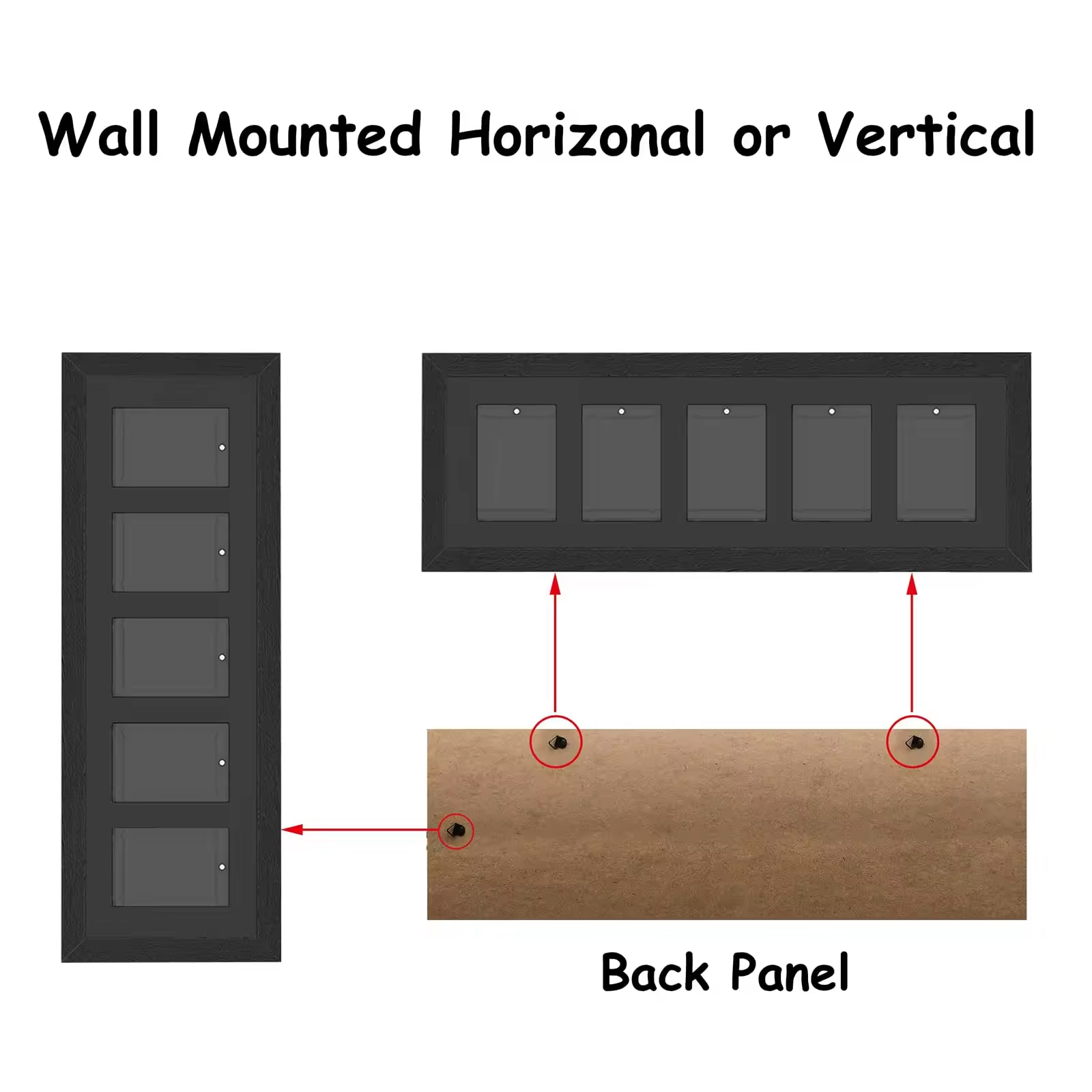
A wall-mount graded card display frame is the basic building block of a slab wall: one standard footprint that can be repeated into a grid or a feature rail.
Choosing Wall Display Frames: UV, Load, and Dust Sealing
Once the pattern is set, the frame specification decides how long the display stays clean and how safe the inventory is. Four specs matter most.
- UV filtering: printed card stock and slab labels fade under ultraviolet light. Choose acrylic or glass specified for high UV blocking, and keep the wall out of direct sun. GUARD TCG display materials are specified for high UV blocking to slow fading on card art and box print.
- Load capacity and mounting: a graded slab is heavier than a raw card. Check the rated weight per frame and use wall anchors rated above the total load, with a safety margin for customers bumping the wall.
- Dust and handling sealing: enclosed or screw-down cases keep dust off the slab and stop casual handling; open trays are cheaper but need weekly cleaning.
- Standard sizing: choose frames sized for standard 35PT slabs and common booster box or UPC formats so new stock always fits without new fixtures.

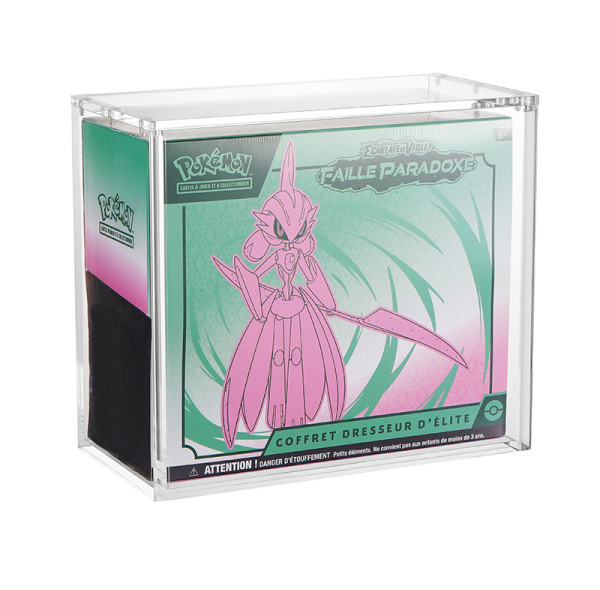
An enclosed acrylic case removes the trade-off between showing a graded card and keeping it protected from dust and fingerprints.
Frame vs. Shelf vs. Locked Case: Display Formats Compared
Wall displays are not one product. Most shops end up using a mix of formats across different walls and traffic levels, and the table below shows how the main options trade visibility, protection, and cost against each other.
| Feature | Wall-Mount Frame | Tiered Wall Shelf | Locked / Screw-Down Case |
|---|---|---|---|
| Visibility from across the room | High — facing out at eye level | Medium — items lean, sightlines overlap | Medium — behind glass or lid |
| Dust protection | High when sealed or gasketed | Low — open to air | Highest — fully enclosed |
| Handling / theft risk | Low to medium | Highest — easy to grab | Lowest — requires tools or staff |
| UV protection | Good if UV-rated acrylic is used | Poor — no filter, direct light | Good to excellent |
| Best for | Graded slabs, feature walls | Bulk slabs, rotating stock | Grails and highest-value stock |
| Typical cost band | Medium | Lowest | Highest |
| Restocking effort | Moderate | Lowest | Highest |
| Where it belongs | Main feature wall at eye level | Secondary wall or back room | Counter or premium corner |
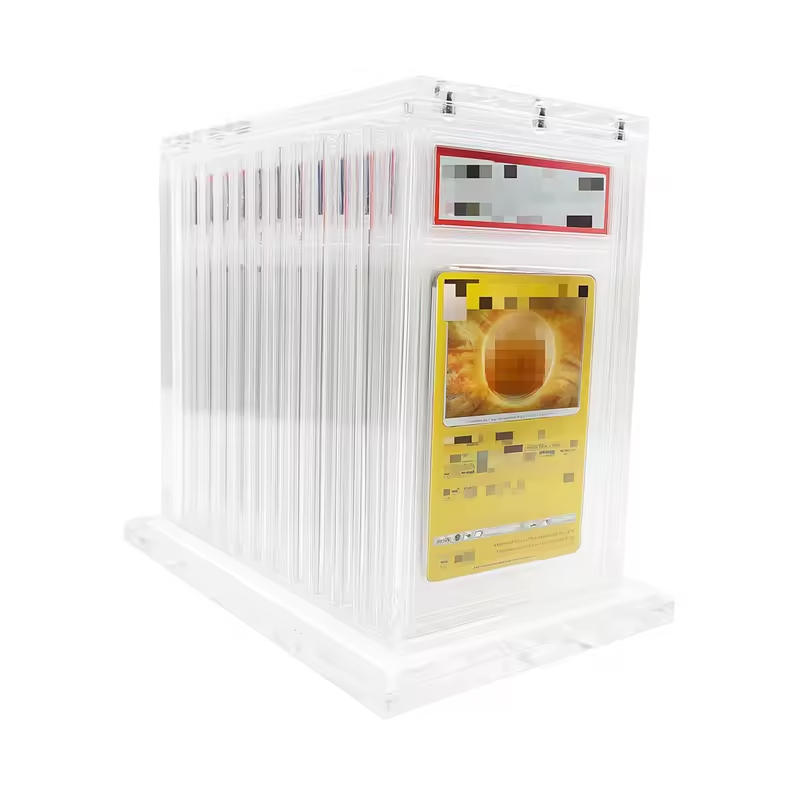
Multi-slab acrylic storage cases work as the counter-side companion to a wall: rotation stock stays protected and inventory is countable at a glance.
Lighting and Rotation: Preventing Fade on Displayed Slabs
Displayed cards fade because of cumulative light exposure, and the biggest contributor is ultraviolet radiation from daylight and unshielded lamps. The control strategy has three parts. First, filter: use UV-blocking acrylic on the frames and, where possible, UV film on nearby windows. Second, separate heat from light: if the wall uses spotlights, prefer LED fixtures that emit little UV and keep them at a distance so heat does not warm the slabs. Third, rotate: treat long-displayed cards as "on tour," swapping them out every few months so no single slab absorbs years of exposure.
As a rule of thumb, the items most at risk are vintage cards with light-sensitive print and slabs whose labels have already aged. Industry guidance on archival display treats UV exposure as cumulative rather than instantly damaging (industry estimate) — meaning small daily exposure over two or three years can visibly dull a card that looked perfect on day one. Rotation, not just filtering, is the cheapest insurance.

Standardised acrylic holders let a wall mix card sizes without losing the uniform look that makes a display read as a collection rather than clutter.
The ROI of a Graded Card Wall
A slab wall is a fixture purchase with a marketing return, so judge it on three metrics rather than on the cost of the frames.
- Stop-through rate: how many passers-by slow down or enter after the wall becomes visible from the street or mall corridor.
- Dwell time and enquiry: measure whether average visit length and the number of "can I see that card?" conversations rise in the months after installation.
- Accessory attach rate: if the wall sits beside slab sleeves, bumpers, and storage cases, watch units per transaction, because the display creates the need the accessories satisfy.
Because the fixtures are reusable, the cost is one-time and the exposure is continuous. A wall also lowers marketing spend indirectly: photographed slab walls are among the most shared images from local card shops, so part of the reach is earned media rather than paid.

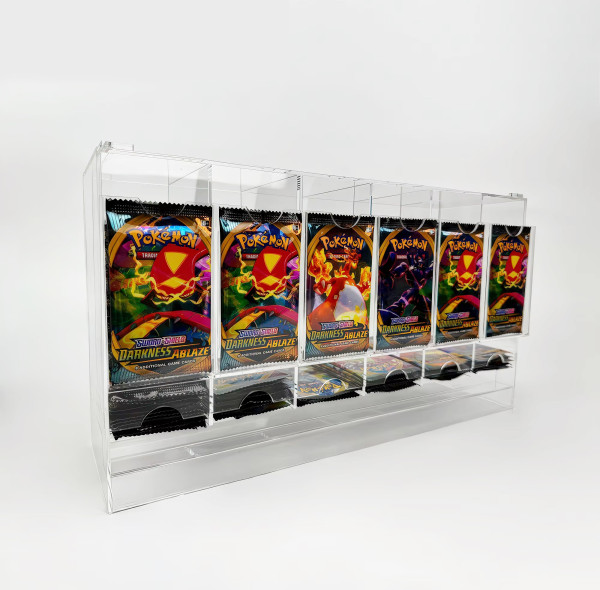
Uniform acrylic cases extend the same visual language from graded slabs to sealed product, so the wall and the shelf read as one deliberate scheme.
Best Practices for Installing and Maintaining a Card Wall
- Plan the wall on paper first: mark eye level, count frame positions, and check that slab dimensions are uniform before ordering.
- Anchor into studs or use rated wall anchors, and test the load before hanging the most valuable slab.
- Keep the bottom row above waist height so bags and backpacks cannot strike it.
- Label or number positions so staff can spot a missing frame immediately.
- Clean with a soft microfibre cloth and non-abrasive cleaner; never spray liquid directly onto acrylic.
- Record which slabs are on display and rotate them on a fixed schedule to limit cumulative UV exposure.
- Re-plan the wall with each major set release so it reflects current inventory and current chase cards.
Common Mistakes to Avoid
- Hanging the wall in direct sunlight without UV-filtering acrylic or window film.
- Using open shelves for the highest-value slabs, where handling and theft risk are highest.
- Mixing frame sizes and colours so the wall looks accidental rather than curated.
- Mounting above the natural eye line, where customers see the wall but never read a grade.
- Leaving the same slabs up for years, letting cumulative UV exposure dull the very cards the wall was built to promote.
- Ignoring load ratings on heavy multi-slab cases, especially on drywall without proper anchors.
About GUARD TCG
GUARD TCG is the card-protection brand of a Chinese manufacturing group founded in 2009, producing over 300 million protective products a year for more than 10,000 customers and 500+ distributors across 70+ countries. The factory runs OEM and ODM programs for sleeves, toploaders, binders, deck boxes, and acrylic display cases, with standard MOQ from 100 pieces, full batch-level QC inspection, and worldwide shipping via DHL, FedEx, and UPS in 5–12 days or sea freight in 25–35 days. The display guidance in this article comes from supplying thousands of retail and distributor accounts, not from theory.
FAQ
Q1 Will cards on a wall display fade?
They can, because fading is driven by cumulative light exposure, especially ultraviolet radiation. Use UV-filtering acrylic on the frames, keep the wall out of direct sun, prefer LED lighting, and rotate displayed slabs every few months to spread exposure across the collection.
Q2 Should I display my most valuable slabs on the wall?
Display them where they are visible but protected — an enclosed or screw-down case on the feature wall or behind the counter. Open shelves are best reserved for rotating or bulk graded stock, because they carry the highest handling and theft risk.
Q3 How many slabs fit on a typical shop feature wall?
It depends entirely on frame size and spacing, so plan it as a grid first: measure usable wall width and height, choose one standard frame footprint, then divide. Standardising on one frame size is what allows a wall to hold dozens of slabs in a clean matrix rather than a scattered few.
Q4 Do I need special frames for different grading companies?
PSA, BGS, and CGC slabs differ slightly in dimensions, so check the internal clearance of any frame or case against the brands you actually stock. Choosing holders sized for standard 35PT-style slabs keeps most of a wall compatible and future-proof.
Conclusion
A graded card wall display turns slabs into store decor by doing three things at once: it protects valuable inventory from handling, dust, and UV fade; it advertises a shop's depth and credibility the moment a customer walks in; and it creates the photo-friendly, conversation-starting surface that drives dwell time and social reach. Choose one layout pattern and one frame footprint, specify UV-filtering acrylic, mount heavy cases with rated anchors, light the wall with low-UV fixtures, and rotate displayed slabs on a schedule. Browse our card protection and display products to build the wall, or contact us for retail and wholesale display solutions.