How Game Stores Profit from TCG Accessories: Margin Benchmarks for 2026
How Game Stores Profit from TCG Accessories: Margin Benchmarks for 2026
For most game stores, TCG accessories carry a retail gross margin of roughly 50-70%, noticeably higher and far more predictable than the 20-45% typical of sealed booster packs and the highly variable margin on single cards. Sleeves, toploaders, binders, deck boxes and acrylic display cases are the quiet cash-flow engine of a card shop: low unit cost, high repeat purchase, no chase-rare risk, and steady demand whether or not the current set is a hit. This guide breaks down 2026 margin benchmarks by category, how accessories compare with sealed product and singles, how to price without racing to the bottom, and how sourcing factory-direct protects the margin you just earned. GUARD TCG has manufactured card accessories since 2009 and supplies 500+ distributors across 70+ countries, so these are the economics we watch retailers run every week.
What Are TCG Accessory Margins and Why Do They Matter?
A TCG accessory margin is simply the difference between what your store pays for an accessory and what a customer pays you, expressed as a percentage of the retail price. If you buy a 100-count pack of standard sleeves at $5.20 and sell it at $9.99, your gross margin is about 48%. If you buy an acrylic display case at $6.00 and sell it at $19.99, your gross margin is roughly 70%. Those two products sit in the same category but behave like different businesses — which is exactly why category-level benchmarking matters more than a store-wide average.
Accessories matter because they change the shape of your profit, not just the size. Unlike singles, they do not require you to predict which card will spike. Unlike sealed product, they do not sit in a warehouse depreciating between reprints. ICv2's long-running hobby-retail reporting consistently splits store revenue into sealed product, singles, accessories and events, and accessories have quietly grown into one of the most dependable slices of that mix — the category that still sells on a slow Tuesday in February.

Sleeves are the workhorse of accessory margin: the lowest price point on the shelf, the highest purchase frequency, and the product that brings customers back every time they build a new deck.
Accessories vs. Booster Packs vs. Singles: Margin Structure Compared
The table below reflects the ranges we see across our retailer and distributor accounts. Treat every number as an industry estimate — distributor terms, shipping costs and local VAT move them a few points in either direction, and singles margins depend heavily on how a store acquires its inventory.
| Feature | TCG Accessories | Sealed Booster Product | Single Cards |
|---|---|---|---|
| Typical retail gross margin | 50-70% (industry estimate) | 20-45% (industry estimate) | 30-60%, highly variable |
| Margin predictability | High — pricing is stable year-round | Medium — set hype swings demand | Low — market-driven daily |
| Inventory risk | Low — accessories do not rotate out | High — reprints crush value | Very high — price spikes reverse fast |
| Shelf life | Multi-year, format-agnostic | Tied to the current set cycle | Depends on meta and ban list |
| Restock frequency | Predictable, monthly or quarterly | Spiky — release-day driven | Constant buy/sell churn |
| Cash conversion speed | Fast on small unit prices | Slow on high unit prices | Variable, depends on sell-through |
| Attach and bundle potential | Very high — pairs with every purchase | Moderate | Low — buyers self-select |
| Best role in your P&L | Stable gross profit base | Traffic driver | Upside and prestige |
Which Accessory Categories Carry the Highest Margins?
Not every accessory earns the same return. In a typical card shop, the ranking below holds up across regions, because it tracks two things at once: how much perceived value the product carries and how cheaply it can be bought in volume.
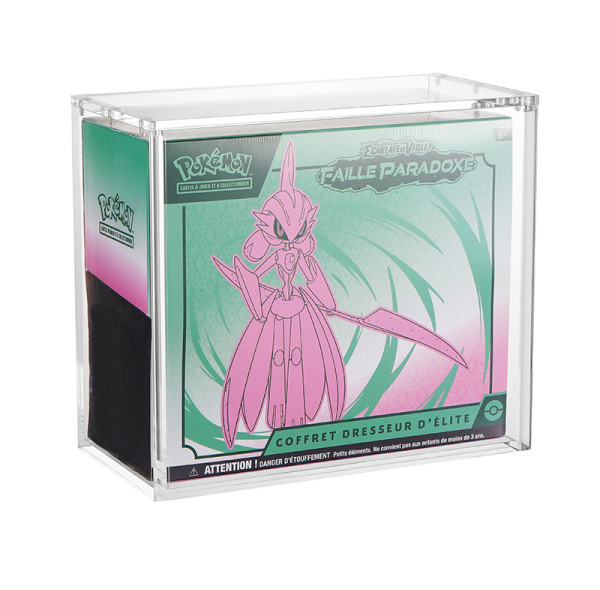
- Acrylic display cases and showcase boxes (60-75%): the highest-margin accessory line for most stores. Perceived protection and display value are high, unit cost is low, and they sell to both collectors and retail shoppers.
- Deck boxes and tournament cases (55-70%): strong margins with a natural tournament-season demand curve; magnet-closure and convertible cases anchor the high end.
- Binders and albums (50-65%): higher ticket than sleeves, so each sale moves more absolute profit, though turnover is slower.
- Sleeves, inner sleeves and toploaders (45-60%): the lowest percentage margin of the accessory families but the highest turnover and the best attach rate — the bread and butter of daily revenue.
- Playmats and custom prints (50-65%): margin depends on whether you buy stock designs in bulk or pay for custom tooling; custom prints raise unit cost but can carry a premium.
- Slab accessories — bumper, sleeves, magnetic holders (55-70%): a fast-growing niche as more collectors buy graded slabs and want to protect them.
How to Price TCG Accessories Without Racing to the Bottom
The single biggest mistake we see retailers make is treating accessories as a loss leader. Deep discounts on sleeves train customers to wait for sales and destroy the exact margin that makes the category valuable. A healthier structure has three tiers.
- Anchor at MSRP for singles: sell one pack or one deck box at full manufacturer-suggested price. It sets the reference point for everything else.
- Reward bundles, not line items: a "deck-building kit" of sleeves plus a deck box plus a playmat at a combined discount protects margin better than marking down each item separately.
- Use membership pricing deliberately: a 5-10% member discount on accessories is usually cheaper than the loyalty you would otherwise buy with advertising, and it makes the discount feel earned rather than permanent.
- Keep high-margin display cases off the discount rack entirely: they sell on perceived quality; a price cut signals a quality cut.
- Never price below your landed cost plus freight and duty: your unit cost is not the FOB price — it includes shipping, import charges and any QC or sample costs.

Deck boxes are the classic mid-tier margin product: high enough price to matter, low enough cost to bundle, and a clear upgrade path from entry plastic boxes to magnet-closure tournament cases.
Buying and Sell-Through: SKU Planning That Protects Margin
Margin is only real if the product actually moves. Overstocking kills accessory profitability faster than underpricing, because accessories are bulky and your shelf space is finite. A practical 2026 SKU plan for a store doing most of its revenue in TCG looks like this: three sleeve formats (standard, Japanese, inner), two toploader thicknesses, two binder sizes, two to three deck box price points, and two to four display cases tied to the product lines you actually stock. That is roughly 20-30 accessory SKUs — enough to cover demand without tying up cash in slow variants.
Track sell-through by category every month, not by individual SKU every week. If a category is turning over its stock more than four times a year, it is under-ordered. If it turns less than twice, you are carrying dead weight. And when you do restock, remember that our standard accessory lines start at a minimum order quantity of just 100 pieces, which makes it realistic to test a new category with a small trial order before committing shelf space and cash to it.
The Landed-Cost Math Behind Your Real Margin
Most retailers calculate margin from their invoice price and then wonder why the category underperforms. The honest calculation is: retail price minus (goods cost + freight per unit + duty and clearance + any QC or rework cost) divided by retail price. For air shipments from China, express courier delivery in 5-12 days is typical through DHL, FedEx or UPS; for full production orders, sea freight in 25-35 days delivers the lowest cost per unit. A 100-piece trial order shipped by courier can easily carry a freight cost per unit three to five times higher than a full container — which is fine for testing, but it should never become your ongoing landed cost.

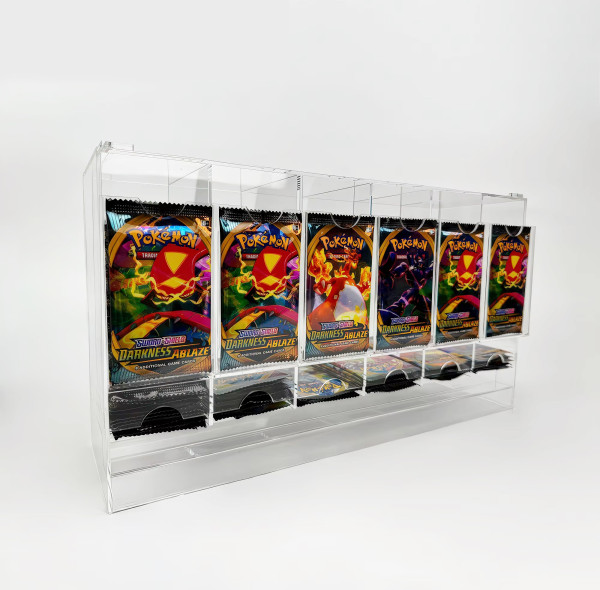
Retail display hardware like a booster pack dispenser box earns margin twice: once when you sell it to a store, and again through the incremental pack sales it drives at the counter.
Best Practices: Benchmarks and KPIs to Track Monthly
- Category gross margin: target 50-70% blended across accessories; investigate any family that drops below 45%.
- Accessory attach rate: aim for at least one accessory item on 30-40% of transactions — Wizards of the Coast's retailer guidance has long pointed at accessories as the easiest profitability lever in a store.
- Inventory turns: four-plus turns per year for sleeves and toploaders, two-plus for display cases and binders.
- Shrink on high-value display items: keep it near zero by using lockable or screw-down cases rather than open shelving.
- Supplier reliability: batch-level full inspection on every order, documented lead times, and a consistent spec sheet matter more than a few cents of unit price.

Screw-down graded card cases sit at the top of the margin ladder: they protect inventory from theft, present slabs beautifully, and customers rarely comparison-shop them on price alone.
How to Choose an Accessory Supplier That Protects Your Margin
Your supplier sets the ceiling on your margin before you ever set a retail price. Working factory-direct rather than through a trading company typically removes one layer of markup, and a manufacturer that also produces custom OEM and ODM lines can grow with you as your store brand expands. Look for a supplier that publishes its specifications, offers MOQ from 100 pieces on standard lines, documents freight options, and runs batch-level quality inspection rather than sampling only a few cartons.

Higher-ticket albums add absolute profit per sale, which is exactly what a store needs when foot traffic is steady but basket size is flat.
About GUARD TCG
GUARD TCG has manufactured trading card protection and display products since 2009, producing more than 300 million pieces a year for 10,000+ customers and 500+ distributors in over 70 countries. Our catalogue covers card sleeves, toploaders, magnetic holders, binders, deck boxes and acrylic display cases, with OEM and ODM programs for retailers, distributors and store brands. Standard items start at 100 pieces MOQ, orders ship by DHL, FedEx or UPS in 5-12 days or by sea in 25-35 days, and every batch passes full inspection before it leaves the factory. Explore our full product range, learn about our factory, or request wholesale pricing for available products.
FAQ
What is a realistic profit margin for TCG accessories in 2026?
Most stores should plan on 50-70% gross margin across a blended accessory assortment, with sleeves and toploaders at the lower end and acrylic display cases at the higher end. Anything below 45% usually signals either a pricing problem or a supply chain that has too many middlemen in it.
Are accessories more profitable than selling single cards?
On a percentage basis, usually yes — and far more predictable. Singles can deliver spectacular margins on the right card, but they also carry real downside risk when prices move. Accessories deliver modest, repeatable margin with almost no inventory obsolescence.
How much should I charge for a pack of card sleeves?
Anchor your standard sleeves at the manufacturer's suggested retail price and reserve discounts for bundles and members rather than individual packs. Then check your landed cost — including freight and duty — before you assume the margin is what your invoice suggests.
What is the best accessory to add first if my store only stocks cards?
Start with sleeve packs and toploaders, because they attach to almost every purchase and have the fastest turnover. Add one or two acrylic display cases next; they upgrade your average basket and are the highest-margin item most small stores can stock.
Can I buy accessories at wholesale without ordering thousands of pieces?
Yes. Our standard accessory lines begin at a 100-piece minimum order quantity, which lets a single store or a new distributor test a category before committing to volume. Custom OEM and ODM runs require higher quantities depending on tooling and printing.
Conclusion
TCG accessories are the most reliable profit center in a modern game store, delivering roughly 50-70% gross margin — clearly ahead of the 20-45% typical on sealed booster product and steadier than single-card sales — because they combine low unit cost, high repeat purchase and almost no obsolescence risk. The stores that profit most from them do three things consistently: they benchmark margin by category instead of guessing a store-wide average, they price at MSRP and discount through bundles rather than individual items, and they buy factory-direct with documented specs, low MOQ and batch-level QC so that the margin they earn at the counter survives all the way back to their supplier. Get those three right, and accessories will keep paying your rent long after the current set has rotated out. Back to GUARD TCG home.