Magnetic One-Touch Holders: Are They Safe for Your Cards?
Magnetic One-Touch Holders: Are They Safe for Your Cards?
Yes — a quality magnetic one-touch holder is safe for standard-thickness trading cards, and it is one of the best rigid protectors you can buy for display. The real safety rules are about sizing, not magnets: a properly sized one-touch with a snug cavity holds a bare or lightly sleeved standard card securely with no pressure marks, while thick, patch, or oversized cards need a deeper cavity (55PT, 100PT or higher) to avoid compression. The magnets themselves cannot erase, bend, or damage card stock — trading cards contain no magnetic media. This guide explains exactly which cards are safe, which are not, and how to choose the right holder.
What Is a Magnetic One-Touch Holder?
A magnetic one-touch holder (often written "one-touch" or "one touch" by collectors) is a two-piece rigid case that snaps shut with built-in magnets instead of screws, tape, or sliding channels. The card sits in a recessed cavity between a clear front panel and a solid back panel, and neodymium magnets in the frame hold the two halves together. One-touch holders are sold in a range of cavity depths measured in PT (points), from 35PT for standard cards up to 180PT+ for thick memorabilia cards.
Compared with a toploader — an open-top rigid sleeve — a one-touch offers three advantages: full 360° edge protection, tool-free opening, and a display-grade look. Compared with a graded slab, it is reusable: you can swap the card in and out without breaking a seal.
How a One-Touch Holder Is Built: Magnets, Cavity and UV Layer
Understanding the construction tells you where the safety risk actually is:
- Neodymium magnets: small disc magnets embedded in the frame. Their field strength is modest — enough to hold the case shut, far below the field needed to affect paper, ink or card stock.
- Recessed cavity: the card sits in a milled recess sized to the PT rating. If the card is thicker than the cavity, closing the case compresses it — the one real mechanical risk.
- UV-absorbing front panel: many premium one-touch holders add UV-blocking material to slow ink fading, though no holder should sit in direct sunlight long-term.
- Non-PVC, acid-free materials: archival-grade acrylic or PET frames avoid the plasticizers that can yellow or damage cards over years.
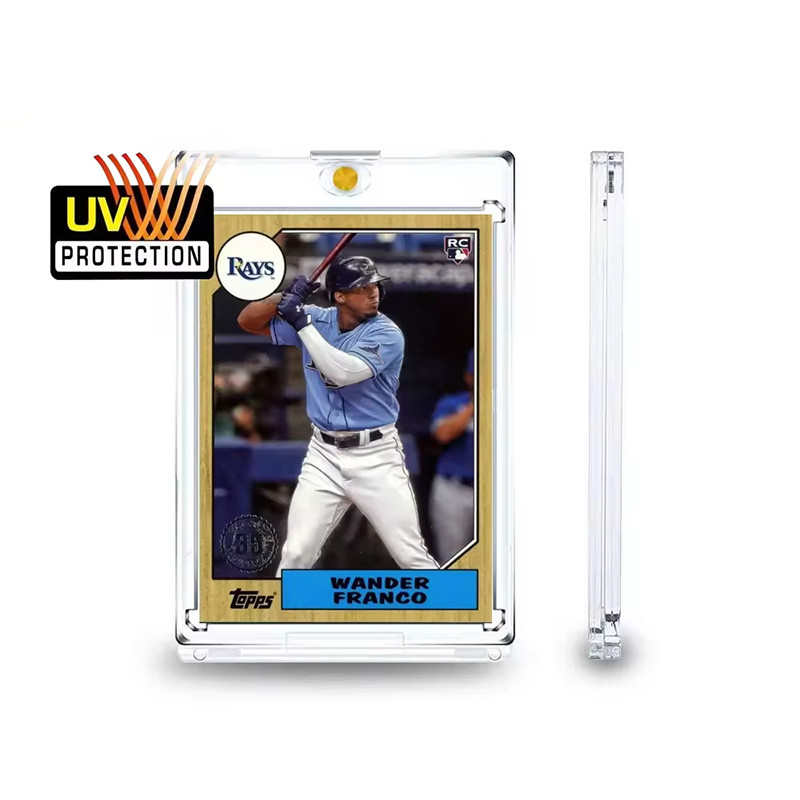
Rigid holders like this one share the same protection logic as a magnetic one-touch: a hard shell with a precisely sized cavity. The holder shown here is our ultrasonic-sealed 35PT slab-style case; the one-touch version simply swaps the ultrasonic seal for magnets so the card can be removed and reinserted.
Are One-Touch Holders Safe for Your Cards?
The short answer: yes for standard cards, with two conditions. Condition one — the cavity must match the card thickness. A standard Pokémon, MTG, Yu-Gi-Oh! or sports base card (roughly 12–20PT with a penny sleeve) fits a 35PT one-touch with a little breathing room, so the card sits still without being squeezed. Condition two — the card should not rattle. If the cavity is too deep, the card shifts and the edges rub against the frame during handling, which is exactly the micro-scratch damage collectors worry about.
- Bare standard card: safe in a 35PT one-touch — the classic use case.
- Single penny sleeve: safe in 35PT; most brands confirm one soft sleeve fits.
- Perfect-fit inner sleeve: safe in 35PT, though some prefer the 55PT "X" versions that are specifically designed to fit sleeved cards.
- Double-sleeved card: needs 55PT or a one-touch X model — 35PT will compress it.
- Chrome, Prizm, Optic premium stock: safest in 55PT.
- Patch, relic, thick autograph cards: needs 100PT, 130PT or 180PT; never force them into a 35PT.
Do Magnets Damage Trading Cards?
No. This is one of the most persistent myths in the hobby, and the physics is clear. Trading cards are printed cardboard with ink — they contain no magnetic stripe, no chip, and no magnetic storage media. The neodymium magnets in a one-touch holder produce a weak localized field (typically a few hundred gauss at the magnet surface, dropping off within millimeters) that has no effect on paper fibers, printing ink, or foil holograms. The "magnets erase cards" fear migrated from old credit cards and magnetic tapes, which store data magnetically — trading cards do not.
Two practical caveats: keep one-touch holders away from old magnetic-stripe cards and hard drives (a strong magnet can erase a stripe), and do not hold a one-touch directly over an old CRT or compass. None of this affects the card inside the holder.
Which Cards Should NOT Go in a One-Touch Holder?
Even with perfect sizing, some cards are better protected elsewhere:
- Odd-shaped cards: square, mini, jumbo, or booklet cards do not match standard cavities — a toploader or specialty sleeve fits them better.
- Cards with attached pieces: coins, dice, or relic cards with protruding parts can be pressed by the frame when the case closes.
- Thick multi-layer patches: unless you confirm the exact PT, a patch card can be compressed at the edges. Measure with a caliper first.
- Cards you plan to grade: PSA, BGS and CGC submission guidelines generally prefer cards in Card Savers or toploaders, not magnetic holders — check the grader's current packaging rules before shipping.
- Very humid environments: a sealed one-touch traps air inside; if you live in a high-humidity region, add a desiccant pack in storage or use breathable options for long-term storage.
One-Touch vs. Toploader vs. Graded Slab: Which Is Safest?
All three are safe when matched to the card. The difference is what they optimize for:
| Feature | Magnetic One-Touch | Toploader | Graded Slab |
|---|---|---|---|
| Edge protection | Full 360° enclosure | Top edge open | Full 360° sealed |
| Card removal | Easy — open the magnets | Easy — slide out | Not possible without breaking |
| Display quality | Excellent, frame-like | Good, simple | Excellent plus grade label |
| Cost per card | Medium ($3–6 typical) | Low (cents to ~$1) | High (grading fees) |
| Best for | High-value singles on display | Bulk storage, shipping, binders | Certified, authenticated cards |
| Stacking stability | Good, flat top | Good with tape on opening | Good, uniform shape |
For a valuable single card you want to enjoy on a shelf, the one-touch wins. For a 500-card collection or shipping, toploaders are cheaper and safer in a box. For authentication value, nothing replaces a real graded slab.
How to Choose a Safe One-Touch Holder
Safety is decided at purchase time. Check these four things before you buy:
- Cavity depth (PT): match it to the card. 35PT = standard bare or penny-sleeved cards; 55PT = premium foil and single perfect-fit; 100PT+ = thick cards. When in doubt, size up one step.
- Corner clearance: look for recessed or diamond-cut corners so the card corners never touch the frame — this is what prevents corner dings.
- Material: choose non-PVC, acid-free acrylic or PET frames advertised as archival grade.
- UV protection: optional but worth it for display cards near windows; pair it with indirect lighting anyway.
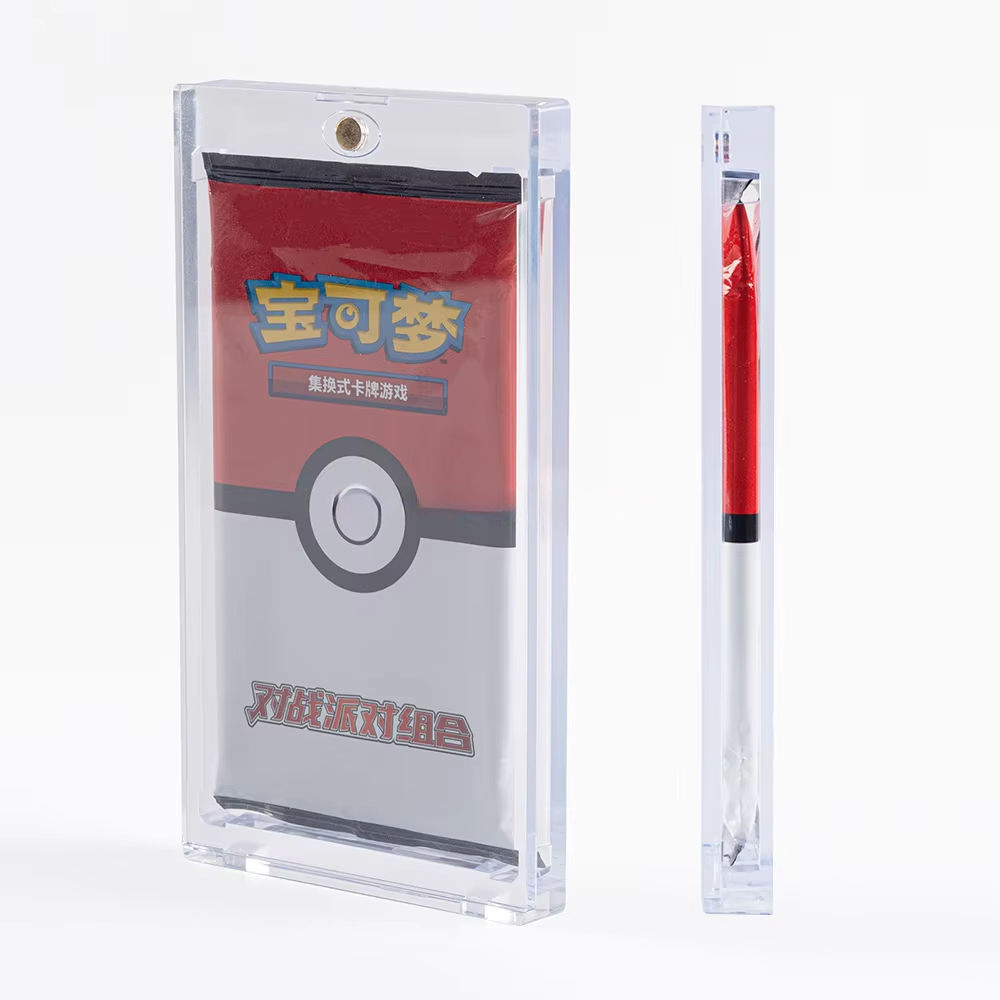
If you prefer an open-top option for bulk storage or shipping, a 35PT toploader is the classic choice — it offers the same rigid shell with a lower cost per card and easier stacking in boxes.
Best Practices for One-Touch Storage
- Sleeve first: a penny sleeve or perfect-fit sleeve prevents micro-scratches and "Newton rings" (pressure marks) from the cavity walls. Choose a one-touch X model if you plan to use sleeves.
- Do not overstuff: if the case does not close flat with light finger pressure, the card is too thick — size up, do not force it.
- Store vertically or flat, not over-stacked: one-touch cases stack fine 5–10 high, but avoid tall unstable stacks that can topple and corner-ding the cases.
- Keep out of direct sunlight: even UV-coated holders degrade over years of direct sun; display in indirect light.
- Clean with a microfiber cloth: acrylic scratches easily — never use paper towels or alcohol wipes on the front panel.
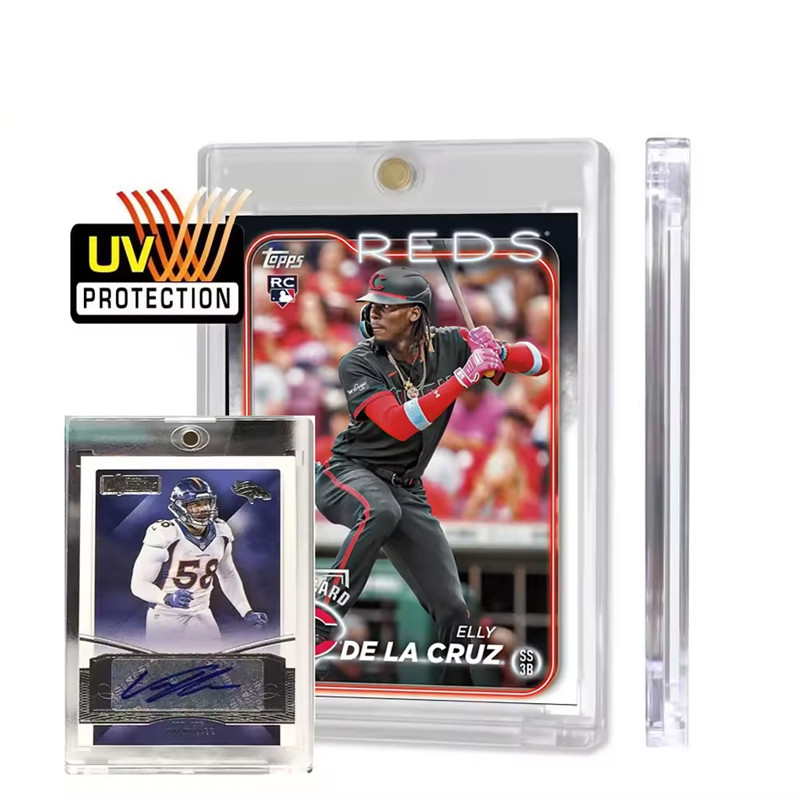
Pairing a soft sleeve with a rigid one-touch is the two-layer approach most serious collectors use: the sleeve handles surface contact, the rigid case handles impact and dust.
About GUARD TCG
GUARD TCG is the card protection division of a factory founded in 2009 that produces over 300 million protective items a year and ships to more than 70 countries for 10,000+ customers and 500+ distributors. We manufacture rigid card holders, toploaders, penny sleeves and graded card accessories shown in this guide, and every batch is fully inspected under our QC process before shipping. Standard MOQ starts at 100 pieces, with DHL/FedEx/UPS delivery in 5–12 days and sea freight in 25–35 days; OEM/ODM customization is available for brands and retailers. See our full product list or send an inquiry for wholesale pricing.
FAQ
Q1: Can one-touch holders be stacked on top of each other?
Yes. One-touch cases have flat, rigid faces, so they stack safely in modest piles (5–10 high). Avoid tall, unstable stacks and keep the pile on a level surface away from edges.
Q2: Do the magnets affect card grading or future grading?
No. Magnets do not alter card stock, ink, or condition, so the card inside is not affected for grading. However, PSA, BGS and CGC submission guidelines generally ask you to ship cards in Card Savers or toploaders rather than magnetic holders — check the current rules before sending.
Q3: Can I put a double-sleeved card in a 35PT one-touch?
Usually not. Two sleeves add roughly 10–15PT of thickness, which makes a 35PT cavity too tight. Use a 55PT holder or a one-touch X model designed for sleeved cards.
Q4: Will a one-touch holder damage a holo or foil card?
No, if the size is right. Foil surfaces are at risk from sliding inside an oversized cavity — so choose a snug fit and, ideally, sleeve the card first so the foil never touches the cavity walls.
Conclusion
Magnetic one-touch holders are safe for standard trading cards when you match the cavity depth to the card: 35PT for bare or penny-sleeved standard cards, 55PT for premium foil and perfect-fit sleeves, and 100PT+ for thick patch and relic cards. The magnets are a non-issue — cards contain no magnetic media — so the only real risks are wrong sizing, forcing a thick card, and long-term humidity. Sleeve first, size correctly, keep them out of direct sun, and a one-touch is one of the safest, most display-friendly protectors you can own. GUARD TCG manufactures rigid card holders, toploaders and sleeves factory-direct — browse rigid card holders or contact us for bulk pricing.
Wholesale and OEM Supply
Need this range in bulk? GUARD TCG manufactures magnetic one-touch card holders and offers OEM/ODM custom card accessories for brands, card shops and distributors. Browse the magnetic one-touch card holders range, or request a wholesale quote.