Pop Reports and Graders' Notes: Reading Data Before You Buy
Card Grading Pop Report: Reading Numbers and Graders' Notes
A card grading pop report shows how many copies of a specific card a grading company has recorded at each grade, while graders' notes flag the defects behind that number. For retailers, distributors and importers buying graded inventory at scale, the two together answer a commercial question: is this grade genuinely scarce, and does the slab in your hand match what the label promises? Population counts tell you supply at a grade; notes tell you why a card stopped there. Read both before you pay a premium, and read both before you quote a wholesale price to your own accounts.
What Pop Reports Are and How to Read Them
A population report is a living database. PSA describes its Pop Report as a record of every card the company has authenticated and graded, updated as submissions process. Beckett, CGC and SGC publish comparable data, and aggregators such as GemRate query several companies at once. None of these is a census of the hobby — they record what has been submitted.
Read four columns, not one: the total graded count, the count at your grade, the count one grade up (what the market considers achievable) and the count one grade down (where your competition sits). A card can be common overall and still scarce in a 10.
Two quirks matter when buying volume. Data lags reality, so today's low pop may be a submission boom arriving next year. And counts are company-specific: 40 examples in a PSA 10 may sit against 6 in a BGS 9.5 — three scarcity stories for one card.
What Graders Notes and Qualifiers Actually Mean
Graders' notes are the audit trail. A Beckett label carries four subgrades — centering, corners, edges and surface — each out of 10, which no other major company prints on the slab. Beckett's overall grade follows the lowest subgrade rather than an average, so 9.5/9.5/9.5/8.5 grades 8.5, not 9.5. That one rule explains much of the price gap between two slabs that look identical in a photo.
PSA and CGC grade holistically but publish qualifiers for structurally sound cards with one specific flaw — off-centering, staining, print defects, miscuts. A qualified grade says the card would have graded higher without it. For a dealer that is a pricing input, not a detail to hide: qualified examples trade well below clean examples of the same numeric grade.
Notes also protect you from a slab that looks better than it is. Centering is the most common reason a sharp card stops at a 9, and submitters widely report Beckett and CGC as stricter on centering than PSA — which makes a BGS 9.5 and a PSA 10 non-interchangeable retail inventory.
| Data signal | What it usually means | What to check | Buyer response |
|---|---|---|---|
| High total, low 10 count | Popular card, brutal grade break | Gem rate, recent submissions | Premium defensible; buy the 10 |
| Low count at every grade | Thin submission history, not rarity | Raw supply and print run | Treat low-pop claims as unproven |
| Population jump this year | Bulk submissions landing | Sellers listing multiples | Delay premium buys; supply coming |
| Wide 9-to-10 price gap | Market pricing the break | Counts at each grade | Grade-9 stock is the volume play |
| Qualifier on the label | Specific defect documented | Which qualifier, how visible | Price as a flawed card |
| Quad subgrades on label | Full four-pillar transparency | The lowest subgrade | Use as condition benchmark |
| Cross-graded slab | Previous grade may differ | Cert history, label era | Verify before accepting it |
Population Data vs. Market Price: How They Relate Compared
Price and population are correlated but not the same measurement, and the gap between them is where dealers make and lose money. Population describes supply at a grade. Price describes one buyer and one seller agreeing once, on one marketplace, on one day: sold data and auction archives are samples, not indices.
The useful question is not "low pop equals high price" but "what is the price multiple between grades, and does the population multiple explain it?" If a 10 costs four times a 9 with ten times fewer 10s, scarcity is priced efficiently. If it costs four times with only twice as many 9s, that premium is fashion and compresses when a submission wave lands.
The reverse case is the one buyers miss: low 10 population with almost no 9-to-10 gap means the market does not respect the break here, often because the 10 is illiquid. Industry estimate: the modern 10-to-9 multiple usually sits between 2x and 5x, but that band moves with set popularity and should never be assumed.
Hunting Grade Breaks and Low-Pop Premiums
A grade break is where the population table collapses — 1,800 examples in a 9, 90 in a 10. Breaks are where premium pricing lives, and where naive buyers get hurt, because a break can be created by grading strictness rather than rarity. A card that is hard to grade is not a card that is hard to find.
Print run decides how many copies exist; grading strictness decides how many reach the top grade. A low 10 population caused by strictness is stable and holds premium. One caused by nobody submitting yet is temporary and evaporates when a group submission targets it. Check the ratio of total graded to top-grade count, then check whether raw copies are still easy to buy: plentiful, cheap raw stock means the 10 population will grow.
For a distributor reselling graded singles, the rule is simple: never pay a low-pop premium for a card whose raw supply you could buy by the box.
Reading Notes Before You Buy: Common Red Flags
Most bad graded purchases are not counterfeit slabs — they are correctly graded cards bought at the wrong price by someone who did not read the label.
A qualifier is the first flag. If the label carries one and the listing calls the card a straight grade, either the seller has not read the label or hopes you have not. Ask for a straight-on photo showing the qualifier, cert number and label era together.
The second is a subgrade pattern that contradicts the price: a Beckett 9.5 with an 8.5 surface is strong but not pristine, and should not be priced against quad 9.5 examples. The third is a population claim without a date — "pop 3" means nothing if it was true eighteen months ago. The fourth is a centering description that conflicts with the image; a listing calling an off-center card "well centered" tells you about the seller's standards for everything else. The fifth is a cert number that will not resolve in the grader's own lookup. Verify every slab you buy in quantity.
How to Choose Which Cards to Chase Using Pop Data
Pop data is a screening tool, not a shopping list. Use it to cut a large candidate set to a shortlist, then apply commercial judgement.
Start with demand. A card with no buyers is scarce by definition and worthless by the same definition. Confirm repeat sold transactions across more than one platform and seller, then check the grade distribution: if the market transacts mostly in 9s, chase 9s, because that is where liquidity sits. If 10s carry a real multiple, chase them in small quantities, since top-grade inventory turns slowly.
Then compare your target grade with the one below. A 10 with 40 examples against a 9 with 4,000 is two businesses: the 9 is a volume product needing thin margins and fast turns, the 10 a trophy needing patient capital and clean provenance. Weight the set too — scarce grades in forgotten sets are slow sales, and slow sales are expensive against a retail delivery date.
Verifying Slabs and Storing New Purchases
Once a slab clears your data checks, the physical work starts. Verify the cert, then inspect the holder for scuffs over the card window, label lifting and any sign the case has been opened. A clean card in a damaged holder is a discount — but it should be priced as one.
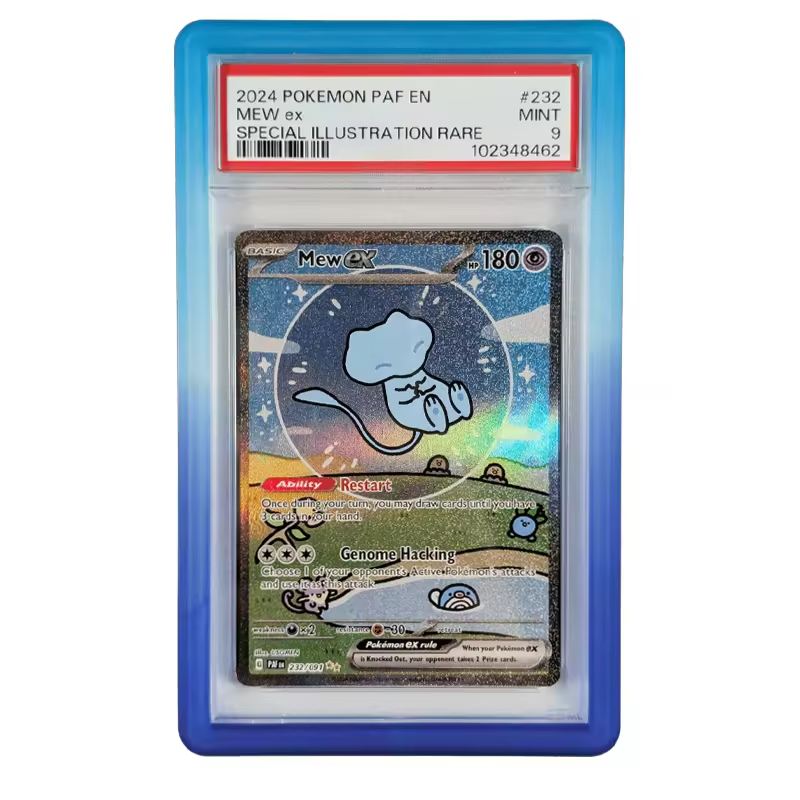
A slab bumper is the cheapest insurance in this category. It absorbs corner knocks in transit and on a retail counter and keeps the holder presentable. For a shop moving dozens of graded singles a month, bumpers are a consumable and belong in case quantities.

For display inventory, an aluminium magnetic case gives a slab retail presence a bare holder cannot match. Compare brand-name alternatives on wall thickness and magnet retention, not finish alone; a case that opens too easily is a liability on a busy counter.

Storage protects the premium you just paid. Slabs loose in a drawer pick up holder wear, and holder wear is the first thing a buyer photographs. A slotted case keeps graded inventory separated, stackable and auditable.

Small-format graded collectibles follow the same rules at a smaller scale: verify, protect, store consistently. Our graded card and slab accessories range covers bumpers, cases and storage for standard holder dimensions.
Wholesale and Retail Notes for Buyers (MOQ, Packaging, Lead Time)
If you are buying slab protection for a shop, a distribution catalogue or an online store, commercial details matter as much as the product. GUARD TCG runs MOQ from 100 pieces per style — workable for a single-store test order and still sensible for a regional distributor.
Packaging is what buyers underestimate. Slab bumpers and cases ship best in inner packs that match how you resell them, so specify inner pack count and carton marking up front. Custom packaging, logo printing and colour matching run through our OEM/ODM programme — the right route if you want your own brand on the shelf rather than a generic SKU.
Lead time is 5–12 days by DHL, FedEx or UPS and 25–35 days by sea. Run the first order on air to test sell-through, then move to sea freight once the SKU proves itself. Every batch is inspected before it leaves the factory; we have supplied 10,000+ customers through 500+ distributors in 70+ countries since 2009.
One more note for buyers assembling a graded-inventory programme: order protection before you order product. A bumper costs a fraction of a returned slab, and a retail account that receives a scuffed holder remembers it. Send holder dimensions and volume through our inquiry form for fit and pricing.
About GUARD TCG
GUARD TCG is a trading card protection manufacturer founded in 2009, producing more than 300 million pieces a year for 10,000+ customers and 500+ distributors in over 70 countries. We make sleeves, toploaders, slab accessories, binders, storage boxes and acrylic display cases, supplying wholesale and OEM/ODM programmes with MOQ from 100 pieces. Every batch is inspected before shipment, and our team supports importers and retailers with packaging specification, private label development and freight planning. Our product catalogue is the place to start.
FAQ
Q1: Does a low population count always mean a card is rare?
No. Population counts record submissions, not total supply. A card can show a low count because few collectors sent it in. Check raw supply and print run before treating low population as rarity, and watch whether counts have been climbing over recent quarters.
Q2: Why is a Beckett 9.5 sometimes worth less than a PSA 10?
The scales are not calibrated to each other. Beckett prints four subgrades and its overall grade follows the lowest, so a 9.5 can carry an 8.5 surface. PSA grades holistically and its 10 is a widely recognised benchmark, which is why cross-company gaps persist.
Q3: How often should I re-check a card grading pop report?
Before every purchase where a scarcity premium is part of the price, and quarterly for inventory you hold. A premium justified by a six-month-old screenshot may no longer hold.
Q4: Do graders' notes change a grade after the fact?
No. Notes document the grade assigned; they do not change it. What changes is the market's interpretation — once a qualifier or weak subgrade is visible, buyers price accordingly. Read it before paying.
Conclusion
Pop reports and graders' notes turn a subjective purchase into a documented one. The table tells you how much supply sits at each grade and whether the price multiple is supported; the notes and subgrades tell you why a card stopped where it did. Read both, verify the cert, and price qualifiers and weak subgrades as what they are.
Then protect what you bought. A verified slab in a damaged holder loses value in transit, and no population research recovers that. Bumpers, cases and slotted storage are the cheap end of a graded-inventory programme — order them before the next submission clears, not after.