Top 10 TCG Storage Mistakes That Quietly Damage Your Cards
Top 10 TCG Storage Mistakes That Quietly Damage Your Cards
Most of the damage that devalues a collection is done slowly, by the storage itself. The ten most damaging TCG storage mistakes are PVC sleeves, direct sunlight, rubber bands, stacking slabs flat, humid basements, cardboard boxes on concrete, unprotected binders in transit, heat above 35C, dust in open display cases, and re-sleeving only when cards look dirty. For retailers, distributors, and importers the risk compounds, because one hot container or one damp warehouse corner turns sellable inventory into grade-limited stock. Damage is cumulative and usually invisible until a card reaches PSA, BGS, or CGC, which is why prevention beats restoration.
Why TCG Storage Mistakes Are Cumulative and Invisible
Card stock is a laminated paper sandwich with a printed ink layer and, on foils, a thin metallic film. Every storage fault removes a small margin from the same three places graders look first: surface, edges, and corners. A single bad cycle does almost nothing. Fifty cycles do.
That is the trap. A collection stored two years at 65% relative humidity looks fine in hand, but under a loupe the surface shows micro-warp, the foil shows a faint cloud, and the card drops from a 9 to a 7.5. Across a 500-card inventory, a two-point slip is not cosmetic; it is a large write-down.
The mechanics are documented. Plasticised PVC migrates into paper and ink, UV breaks dye bonds and yellows clear polymer, heat above roughly 35C softens sealed-product adhesive, and moisture swings curl the paper core faster than the foil layer. None of it announces itself when it happens.
Mistake 1-3: PVC Sleeves, Rubber Bands, and Raw Stacking
Mistake 1: soft PVC sleeves. PVC is cheap, soft, and clear, which is why it appears in low-cost retail packaging, and it is the worst long-term sleeve material. Plasticiser migrates out of the film into the card, the sleeve turns tacky, and the card fuses to the plastic. In advanced cases degraded PVC releases hydrogen chloride, which attacks the ink layer directly. Polypropylene and archival polyester sleeves, binders, and pages do not carry that risk. If a sleeve smells like a shower curtain and feels oily, it is plasticised PVC.
Mistake 2: rubber bands. A band applies constant pressure across a stack, and the two end cards take a permanent edge crease within months. On foils it leaves a pressure line across the surface. Nothing about a rubber band is reversible.
Mistake 3: raw stacking and flat slab piles. Unsleeved cards stacked on each other grind their edges every time the stack is lifted. Slabs stacked flat are a separate problem: the cases are rigid, but the card inside sits on small internal clips, and sustained load plus vibration transfers to the card edge. Slabs belong upright in a fitted case, not in a leaning tower.
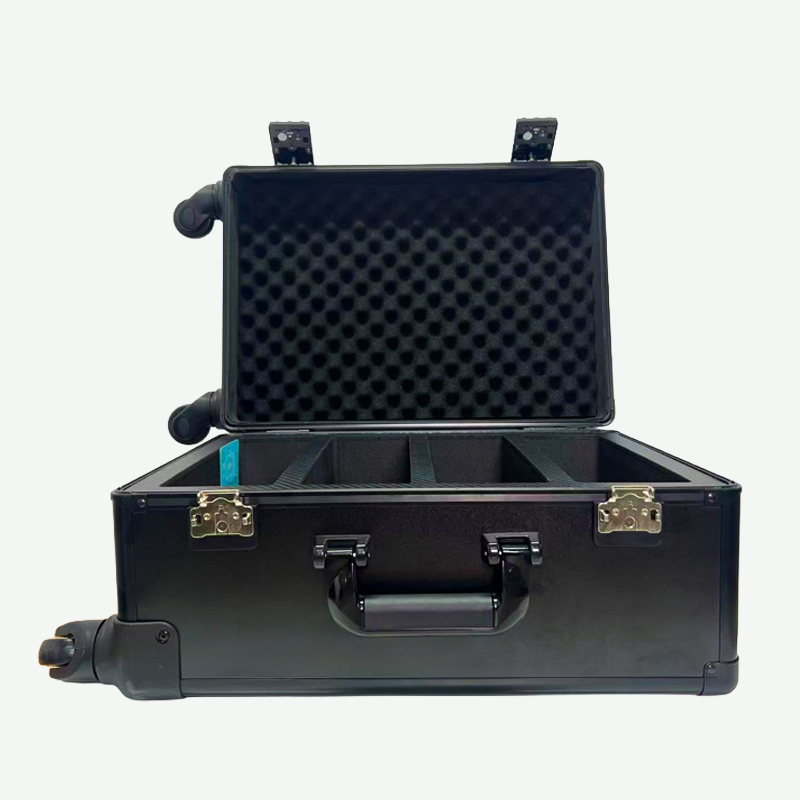
A four-row EVA-lined box holds slabs upright, which removes the flat-stack load that creases cards at the bottom of a pile.
Mistake 4-6: Sunlight, Heat, and Humidity
Mistake 4: direct sunlight. UV is the fastest of the ten faults. A case on a south-facing shelf fades a red foil to washed pink inside one summer, and the fade is not recoverable. Indirect daylight still carries enough UV over years to yellow clear sleeves and dull a black border.
Mistake 5: heat above 35C. In an unconditioned warehouse or a closed car, surface temperatures pass 50C easily. Sealed booster wrap then softens and takes a print of whatever it presses against, and warped cards relax into the warp. Most distributors work to an industry estimate that a single day above 40C is comparable to a year of normal cosmetic ageing.
Mistake 6: humid basements and garages. Published collector guidance converges on 45-55% relative humidity at 18-24C. Below 35% RH cards dry and curl inward; above 60% RH the paper core absorbs moisture, swells, and grows the first faint spots of foxing. Basements and garages swing further than that in one week, which is worse than a stable, slightly high reading.
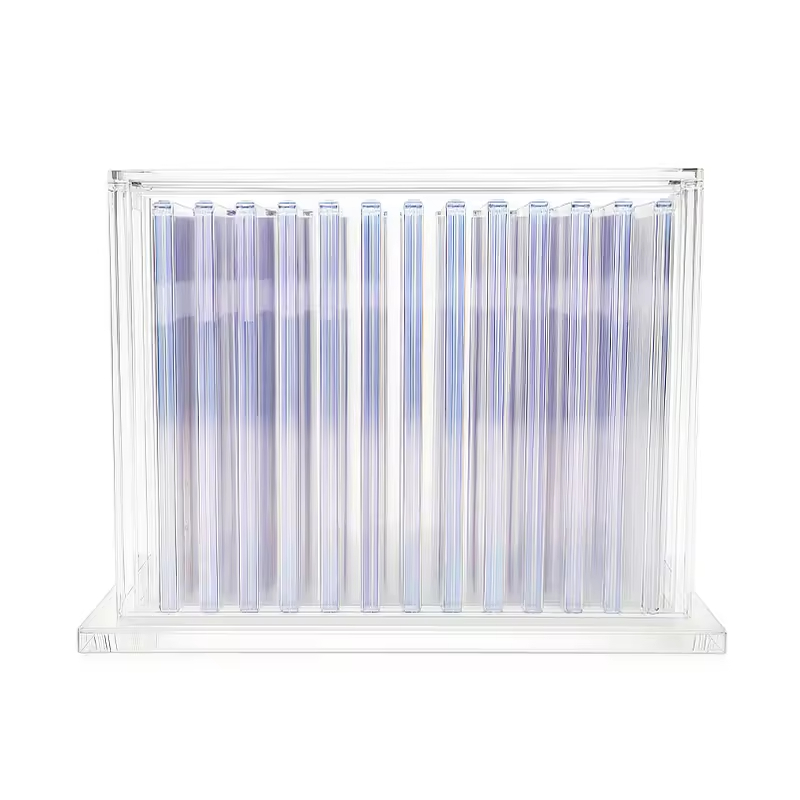
A closed acrylic organizer keeps dust off graded slabs. It does not stop UV, so keep it out of direct sun regardless.
Mistake 7-8: Concrete Floors and Unprotected Transit
Mistake 7: cartons straight on a concrete floor. Concrete wicks ground moisture continuously and passes it into the bottom layer of a corrugated carton. The bottom row of a pallet is where mould starts, and it is the row nobody inspects. Ten centimetres of clearance, on a pallet or a shelf, removes the mechanism entirely.
Mistake 8: binders and slabs in unprotected transit. A binder thrown into a backpack flexes at the spine and the pages fan, so the cards at the front and back of each page take the movement. Slabs loose in a bag crack at the corners, and a cracked slab is a re-holder fee before it is anything else. Transit protection is a rigid outer shell plus a soft inner layer, not more bubble wrap around a flexing object.

A rigid three-slot case is the transit answer: the shell takes impact, the slots stop slabs rubbing on each other.
Mistake 9-10: Open Display and Deferred Re-Sleeving
Mistake 9: open display trays. An open tray on a desk collects dust on the top edge of every card. Dust is mildly abrasive, and each time a card is lifted out and pushed back, grit drags along the surface. Combine a tray with window light and you have two faults in one object: UV fade from above, abrasion from handling.
Mistake 10: re-sleeving only when a card looks dirty. By the time a sleeve looks cloudy, grit has been trapped against the card for months. Sleeves are consumables. Tournament players cycle them in weeks; stored collections should cycle them every 12-24 months, and immediately after any crease, split seam, or tacky feel.
Safe vs Risky Storage Setups Compared
| Storage factor | Risky setup | Safe setup | Why it matters |
|---|---|---|---|
| Sleeve material | Soft PVC, unlabelled import film | Polypropylene or archival polyester | No plasticiser migration into ink |
| Light exposure | South-facing shelf, direct sun | Interior room, UV-filtered case | Stops irreversible dye fade |
| Temperature | Above 35C, closed car, hot container | 18-27C, stable | Prevents warp and seal softening |
| Humidity | Basement, below 35% or above 60% RH | 45-55% RH, monitored | Prevents curl, swelling, foxing |
| Floor contact | Cartons on bare concrete | Pallet or shelf, 10cm clearance | Breaks ground moisture wicking |
| Slab orientation | Flat stacks, leaning towers | Upright in fitted rows | Removes load and edge pressure |
| Transit | Binder in a soft bag | Rigid case, foam inner layer | Absorbs impact before the card does |
| Sleeve age | Replaced when visibly dirty | Replaced on a 12-24 month cycle | Stops trapped grit abrasion |
Seven of those eight differences are decisions, not purchases.
How to Audit Your Own Collection for TCG Storage Mistakes in 30 Minutes
An audit is a walk-through, not a re-sort. Thirty minutes finds the faults that are actually costing money.
- Minutes 1-5, the room. Put a thermo-hygrometer where the collection sits. Above 60% RH or above 30C is a finding, not a background detail.
- Minutes 6-10, the light. If sun reaches the shelf at any hour, that shelf is a temporary location.
- Minutes 11-15, the floor. Check every carton for direct concrete contact, and look for a tide mark or musty smell at the base.
- Minutes 16-22, the sleeves. Pull ten random cards and flex one sleeve. A crackle, a tacky feel, or a yellow tint means the run should be re-sleeved.
- Minutes 23-30, the slabs. Look for cracked cases, corner chips, and any slab stored flat under weight.
Photograph the findings and date them; it is the only reliable record that a card left the warehouse in a given condition.

A closed two-slot case is the cheapest fix for the audit's most common finding: loose slabs moving around in a bag.
Best Practices That Cost Almost Nothing
Never store sealed product against a wall. External walls run hotter and colder than the room, and condensation forms on the cold side of the wrap.
Label and date every box. A storage program that cannot be audited is not a storage program, and date labels tell you when a sleeve cycle is due.
Buy sleeves in the material you can name. If the supplier cannot state the resin, assume the cheapest film available. Material statements are a purchasing question, not a technical nicety.
Wholesale and Retail Notes for Buyers (MOQ, Packaging, Lead Time)
For importers and distributors, storage faults are a landed-cost problem: a container crossing the equator swings through temperatures a retail shelf never sees, and the bottom pallet tier fails first. Packaging specified at order time costs less than a claim later.
MOQ. Stock formats start at 100 units per SKU. Mixed-SKU orders are accepted within a single product family, so a distributor can build a full range without committing 100 units to every item.
Packaging. Standard export packing is a polybag per unit, an inner box, and a five-layer master carton with edge protectors. For rigid storage cases, specify foam end caps and a carton rated for double stacking. For sleeves, specify pack count and a moisture-barrier liner if the destination is tropical.
Lead time. Stock formats ship in 5-12 days by DHL, FedEx, or UPS. Sea freight runs 25-35 days door to door depending on port and season. Custom tooling and branded print add production time, so confirm the schedule before locking a retail launch date.
Inspection. Every batch is fully inspected before packing, with retained samples kept per lot. Ask for the retained-sample reference on the purchase order; it is the cheapest insurance in the transaction.
Buyers building a private-label storage program usually start from the OEM/ODM program page, confirm formats on the card storage boxes and carrying cases and sleeves ranges, and send specifications through the inquiry page. For the positive-side checklist that pairs with this article, see our long-term trading card storage guide.
About GUARD TCG
GUARD TCG has manufactured card protection and display products since 2009, producing more than 300 million units a year for customers in over 70 countries, with 10,000+ customers and 500+ distributors. We run OEM and ODM programs across sleeves, toploaders, binders, deck boxes, storage cases, and acrylic display, with documented material statements, carton data, a 100-unit MOQ on stock formats, and full-batch inspection. Resin, film gauge, foam grade, latch hardware, and cosmetic standard are specified per order, so a buyer can write a storage specification instead of hoping for one.
FAQ
Q1. Are all cheap sleeves PVC?
No. Many low-cost sleeves are polypropylene and perfectly safe. The test is the material statement, not the price. Unlabelled film with a soft, oily hand and a shower-curtain smell is the one to reject.
Q2. Is 45-55% RH necessary, or is that overthinking it?
For bulk commons, no. For anything heading to grading or sitting in inventory for more than a year, yes. Curl and foxing are the two failures that show up at grading and cost the most per card.
Q3. How often should stored cards be re-sleeved?
Every 12-24 months for stored collections, and immediately on any crease, split seam, or tacky feel. Tournament players should treat sleeves as a much shorter-cycle consumable.
Q4. Does a graded slab remove the need for climate control?
No. A slab protects against handling and impact, not heat, moisture, or UV. Slabs left in a hot car still warp, and the case can craze.
Conclusion
The ten TCG storage mistakes on this list share one property: cheap to prevent, expensive to discover. PVC sleeves, rubber bands, flat slab stacks, sunlight, heat above 35C, humidity outside 45-55% RH, cartons on concrete, unprotected transit, open dusty display, and deferred re-sleeving all act slowly enough to be ignored and permanently enough to matter at grading. For retailers, distributors, and importers the fix is a specification written into the purchase order, covering resin, foam grade, carton rating, and retained samples. Prevention is a line item. Restoration does not exist.