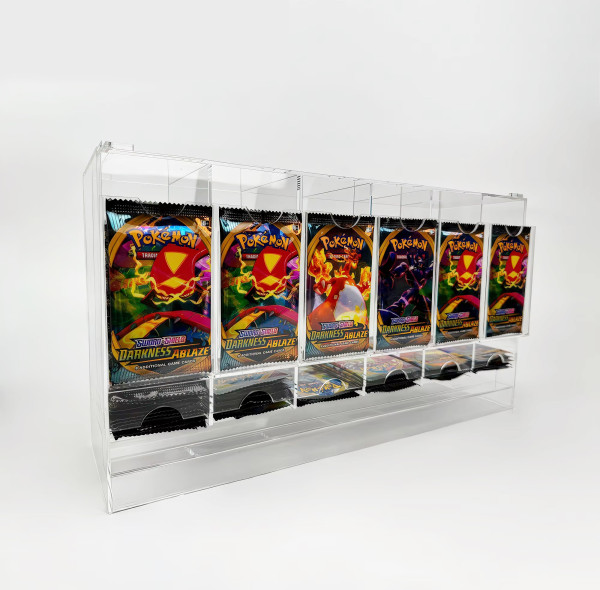
Graded Card Registry Sets: Building and Displaying Complete Sets
Graded Card Registry Sets: Building and Displaying Complete Sets
A graded card registry set is a complete run of a checklist tracked in a public registry, where points and ranking reward consistency and high grades. Building one means targeting uniform grades, filling hard slots early, and budgeting over years, while displaying it safely requires uniform slab storage, UV protection, and a dust-free layout that keeps the whole run visible. This guide is written for retailers, distributors, and importers who sell graded cards or the slab storage around them, plus the collectors who buy from those shelves.
What a Graded Registry Set Is and Why Collectors Build Them
A registry set is not a box of nice cards. It is a defined checklist — a base set, a rookie class, a promo run, a full year of a trading card game — registered against one grader's database, with every slot filled by a card in that grader's holder. PSA runs the best-known Set Registry, CGC Cards runs registries for both trading cards and sports cards, and SGC maintains its own registry. The mechanics are similar across all three: you register cards by certification number, the system matches them to a checklist, and the set is scored.
Why bother? Three reasons hold up. First, a registry turns a vague goal — "finish the set" — into a measurable percentage, which is a far better buying brief than a want list. Second, completeness and grade consistency are scored, so the registry rewards the disciplined buyer instead of the impulsive one. Third, a registered set is a provenance record: it documents which certified example of each card you own, in public, which matters when a set is eventually sold as a single lot.
There is also a commercial angle that shops ignore at their own cost. Registry-driven buyers are repeat buyers with a checklist. They come back for one specific card, then one more, then the holder and storage to keep the run together. A store that understands registry logic can merchandise around it instead of guessing.
Registries, Points, and Ranking Systems Explained
PSA publishes its registry rules plainly: set rankings are determined by the grades of the items in the set, the weight assigned to each item, and the set's completeness. Its registry FAQ describes ranking sets in order of grade point average and completion. CGC's trading card registry awards participants an overall ranking based on the total score of all cards registered in their competitive sets. In practice, both systems are doing the same arithmetic — grade quality multiplied by item weight, scaled by how much of the checklist you actually own.
Two consequences follow, and they drive every build decision. The first is that a single low-grade card can drag a high-average set down more than a missing common slot costs you, because averages punish outliers. The second is that weighting means not all slots are equal: a key card carries more scoring weight than a filler common, which is exactly why those slots are both harder to find and more expensive when you do.
| Factor | PSA Set Registry | CGC Cards Registry |
|---|---|---|
| Set coverage | Deep vintage and modern sports and TCG checklists | Trading card and sports card competitive sets |
| Ranking inputs | Grades, item weight, and completeness | Total score across cards in the competitive set |
| Public comparison | Leaderboards plus all-time great set comparisons | Overall ranking of participating collectors |
| Holder requirement | PSA-certified holders only | CGC-certified holders only |
| Progression rewards | Medals and registry points for completion milestones | Score-based standing within set categories |
| Cross-grading impact | Cards must sit in PSA slabs to count | Cards must sit in CGC slabs to count |
| Best fit for | Vintage runs and high-average modern sets | Trading card sets built from scratch |
The practical implication for a buyer is that your grading submission plan is part of your set strategy, not an afterthought. If the registry you care about accepts only one company's holders, cross-grading decisions have a cost attached, and that cost belongs in the budget from day one rather than at the moment a set is 80% complete.
Uniform Grades vs. Best Available: Building Strategy Compared
Every registry builder eventually faces the same fork. Do you hold out for grade 9 and above across the board, or do you take the best example available and accept an uneven run? Neither answer is wrong, but they produce very different sets, timelines, and cash requirements — and mixing them without deciding is how sets stall at 60% for three years.
Uniform-grade building is the average-first approach. You set a floor, refuse anything below it, and accept that scarce slots may take years. It produces the strongest ranking per completed slot and the cleanest display, because every holder in the case looks the same. The cost is opportunity: a card that appears once a year at grade 8 may not appear at grade 9 for five years, and when it does, the premium is decided by two other collectors who want the same slot.
Best-available building is the completeness-first approach. You fill the checklist, accept grade variance, and upgrade later slot by slot. It gets you to a finished-looking set quickly, which matters if the set is a retail display, a shop attraction, or a collection you want to enjoy now. The cost is a permanent upgrade treadmill: every weak slot is a card you will buy twice.
| Dimension | Uniform-grade build | Best-available build |
|---|---|---|
| Buy target per slot | Fixed grade floor, reject below it | Highest grade in budget at time of purchase |
| Time to 100% | Often 3-6 years on scarce checklists | Often 12-24 months |
| Capital profile | Fewer, larger purchases | Many smaller purchases plus upgrade spend |
| Ranking outcome | Strongest average per completed slot | Weaker average, stronger completeness score |
| Display consistency | Visually uniform holder run | Mixed grades visible side by side |
| Main risk | Set stalls on two or three impossible slots | Permanent upgrade loop and duplicate spend |
| Best fit for | Long-horizon private collections | Shops, displays, and goal-driven newcomers |
A hybrid usually wins: run best-available for the first 70% of the checklist to establish momentum, then switch to a grade floor for the last 30%, where every remaining slot is expensive anyway and patience costs nothing extra. Write the rule down before you start buying, because the discipline is much easier to keep on paper than in an auction's final ten seconds.
Budgeting a Multi-Year Set Completion
Set completion is a capital plan disguised as a hobby. Three buckets keep it honest: roughly 70% of spend on card acquisition, 20% on grading and re-holdering, and 10% on storage and display. Collectors who skip the third bucket end up with a five-figure set in shoeboxes, which is both a preservation failure and a resale discount.
Work backwards from the checklist. Count slots, assign each an expected cost band from recent completed sales, multiply by a realistic grade assumption, and add 15-20% for the slots that will be won at auction rather than bought at a listed price. That total is your set budget — usually a sobering number, which is the point. Then decide the annual pace, not the monthly one: a 400-card set at 100 cards a year is a four-year program, and that framing makes it obvious whether your budget is realistic or aspirational.
Two sequencing rules survive contact with reality. Fill hard slots early, because scarce cards get scarcer and more expensive as the registry population grows. And keep a 10% reserve for the card that appears once, off-cycle, at a price you did not plan for — the reserve is what separates a completed set from a permanently 96% set. Grading submissions deserve their own line item too: bulk tiers are cheaper per card but slower, and re-holdering an entire set later costs more than submitting correctly the first time.
Graded Card Registry Set Display Options: Cabinets, Cases, and Wall Layouts
A complete set is only impressive if it can be seen. Display choices fall into three families, and most serious collections use two of them: a closed storage layer for the bulk of the run, and an open display layer for the highlight slots.
Cabinets and drawer units hold volume. A 400-slot set needs roughly four to six drawers of indexed slab storage, and the constraint is not just space but retrieval: a drawer that holds 80 slabs is useless if finding card 217 takes ten minutes. Index by checklist number, not by grade or value, and label the drawer fronts.
Acrylic cases handle the showcase layer. A 12-slab acrylic case with individual compartments displays a complete page of a set without stacking holders against each other; smaller 2-, 3-, and 4-slot cases with a display face suit the key cards that deserve their own position. Acrylic is the right material here because it is rigid, clear, and does not yellow the way some inexpensive plastics do under light.
Wall layouts handle narrative. A grid of matching cases reads as a set; a scatter of mixed frames reads as clutter. If wall space is the plan, decide the grid dimensions first — 4 x 3, 5 x 4 — and buy cases to that module so the arrangement can grow without being rebuilt.
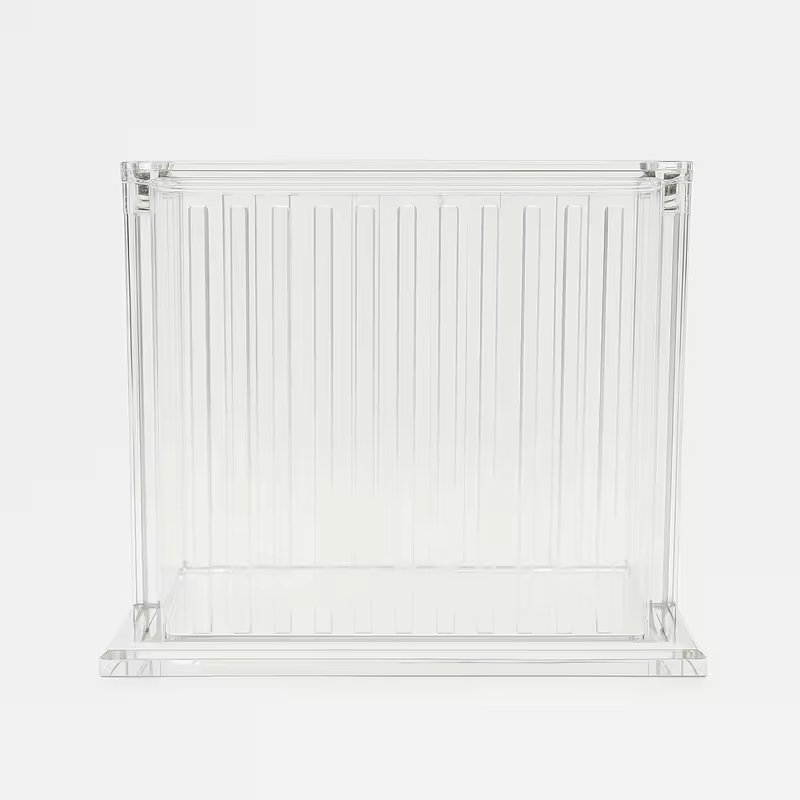
How to Choose Graded Card Registry Set Display Storage That Fits a Full Slab Run
Slab dimensions are not universal. PSA, BGS, CGC, and SGC holders differ in footprint and thickness, and a case built to one company's holder will rattle, jam, or refuse the others. Measure a sample slab from each grader you own before ordering anything, and check the compartment tolerance: a slot that is 2mm too tight scratches labels, and one that is 5mm too loose lets slabs slide and chip at the corners.
Then think in systems rather than single units. The questions that decide long-term satisfaction are unglamorous: does the case stack with a second identical case, or does the lid design prevent it? Is the lid retained by magnets, friction, or a hinge that will fatigue? Does the interior use a soft liner so label edges are not abraded every time the case opens? Can you buy the same model again in a year, or is it a one-off SKU that will break your visual run?
Capacity math is where most buyers undershoot. A 200-card set with 30 key cards on display still needs closed storage for 170 slabs, plus room for the upgrade duplicates that accumulate along the way. Buy for the finished set, not the current count, and prefer modular units that expand by one drawer or one case at a time over a single large cabinet that has to be replaced.

Material matters more than finish. UV-filtering acrylic slows fade on the cards you display; ordinary clear plastic passes most of the damaging spectrum. If a case is going near a window or under retail lighting, UV filtering is not a premium upgrade, it is the specification. For the closed layer, a rigid box with a foam or EVA interior protects better than a soft sleeve, and it keeps dust off labels that are otherwise impossible to clean without risk.
If you are comparing container types rather than display units, our breakdown of graded card binders versus storage boxes covers the trade-offs, and the graded card slab accessories range shows the current formats side by side.
Handling, Rotation, and Climate Best Practices for Displayed Sets
Display is a slow-motion storage decision, so the climate rules do not change when a card moves from a drawer to a shelf. Specialist storage guides recommend keeping relative humidity in the 30-50% range to limit warping, mould, and label degradation, and holding room temperature stable at roughly 18-24°C (65-75°F). Attics, garages, and basements are disqualified by definition — they swing far outside that band.
Light is the second variable. Direct sun and unshielded display lighting fade inks and yellow slabs over years, not weeks, which is why the damage is usually discovered by the next owner. Keep displayed sets out of direct sun, prefer LED sources, and use UV-filtering acrylic wherever the collection is lit.
Handling rules are simple and worth repeating to staff: lift slabs by the edges, never by the label window, and never stack them flat under weight. Stacking puts pressure on the holder and abrasion on the label; our guide to the hidden risks of stacking graded slabs explains why upright, slotted storage is the safer default.
Rotation is the maintenance habit that keeps a displayed set safe and interesting. Every quarter, pull the display run, inspect each slab for dust, label lift, or corner chipping, dust the cases with a microfibre cloth and no solvent, and rotate which 20-30 cards are on open display. Rotation spreads light exposure across the set and turns inspection into a routine rather than a rescue operation.

Wholesale and Retail Notes for Buyers (MOQ, Packaging, Lead Time)
MOQ. Stock slab storage formats typically start at 100 units per SKU, which is workable for a single shop testing a display wall or a small distributor adding one line. Custom compartment layouts, branded lids, foam inserts cut to a specific grader's holder, and private-label printing usually require 500-1,000 units because tooling and setup have to be amortised. Aggregate your SKUs — 12-slot cases, 4-slot display cases, and closed storage boxes ship well together — before you negotiate a price tier.
Packaging. Acrylic display products live or die on packaging. Specify corner protection, a scratch-resistant film, and a retail-ready box with a printed sleeve if the unit will sit on a shelf; plain export cartons cost less but shift the repacking work to your warehouse. For graded cards moving between your store and customers, ask about graded card guard packaging — foam-lined mailers and slab sleeves sized to the holders you actually ship — since a chipped slab corner in transit is a return, not a sale.
Lead time. Allow 5-12 days for express samples and urgent replenishment, 25-35 days for sea freight, plus production time that depends on moulding and printing. Land the first order six to eight weeks before your selling season, and reorder on sell-through rather than the calendar. Every batch is inspected before it leaves the factory, and retained samples let you compare a reorder against the original run.

For retailers, the merchandising logic is straightforward: pair a display case with the graded cards or the slab sleeves a registry builder needs, and put a small "build your set" explainer beside it. Registry collectors are goal-driven buyers, and a store that stocks the storage layer for a full run earns the reorder, not just the single sale.
About GUARD TCG
GUARD TCG has manufactured card protection and display products since 2009, producing more than 300 million units a year for customers in over 70 countries, with 10,000+ customers and 500+ distributors behind us. We run OEM and ODM programs across sleeves, toploaders, binders, deck boxes, and acrylic display, with documented material statements, carton data, a 100-unit MOQ on stock formats, and full-batch inspection. For slab storage sized to a specific grader's holder, start with the OEM/ODM program page, browse the graded card slab accessories and acrylic display cases ranges, or send dimensions and volumes through the inquiry page.
FAQ
Q1. Does a graded card registry set need every card graded?
Yes for the registry itself — only cards in that grader's holders can be registered, and a raw card cannot fill a scored slot. Many collectors keep a raw or binder set alongside the graded run for reading and deck use, but the registry percentage only counts certified examples.
Q2. Which matters more for ranking, grade or completeness?
Both are scored. PSA states that rankings weigh grades, item weight, and completeness, and its registry literature describes ranking by grade point average and completion. In practice a high average with a few missing heavy slots can rank below a slightly lower average that is 100% complete, which is why the last few slots are worth disproportionate effort.
Q3. Can I mix PSA, BGS, and CGC slabs in one set?
Not within a single registry set. Each registry accepts only its own certified holders, so a mixed run has to be cross-graded before it scores. That is a real cost — budget for re-holdering before you buy a set with mixed slabs and assume the grade may shift.
Q4. How many slabs does a display case hold, and is that enough?
Common acrylic cases hold 2, 3, 4, 6, or 12 slabs. Display capacity is a fraction of set capacity: a 200-card set typically displays 20-40 highlight slabs and stores the rest closed. Plan the closed storage first, then choose the display module.
Q5. What humidity should a displayed set be kept at?
Specialist storage guides recommend 30-50% relative humidity and a stable 18-24°C (65-75°F). Avoid attics, garages, and basements, keep displays out of direct sun, and inspect slabs when you rotate the display each quarter.
Q6. Is UV-filtering acrylic worth the extra cost?
For anything displayed under light for years, yes. Fading and label yellowing are cumulative and irreversible, and UV-filtering acrylic slows the process at a small premium over standard clear material.
Conclusion
A registry set is won by sequencing, not by spending: pick the registry, set a grade rule, fill scarce slots early, budget across years, and give the finished run storage that matches how many slabs you will actually own. Display the highlights, store the whole checklist upright, rotate quarterly, and keep the climate inside 30-50% humidity and 18-24°C. To compare slab storage formats against your own checklist size, browse the full catalog or request samples through the inquiry page.